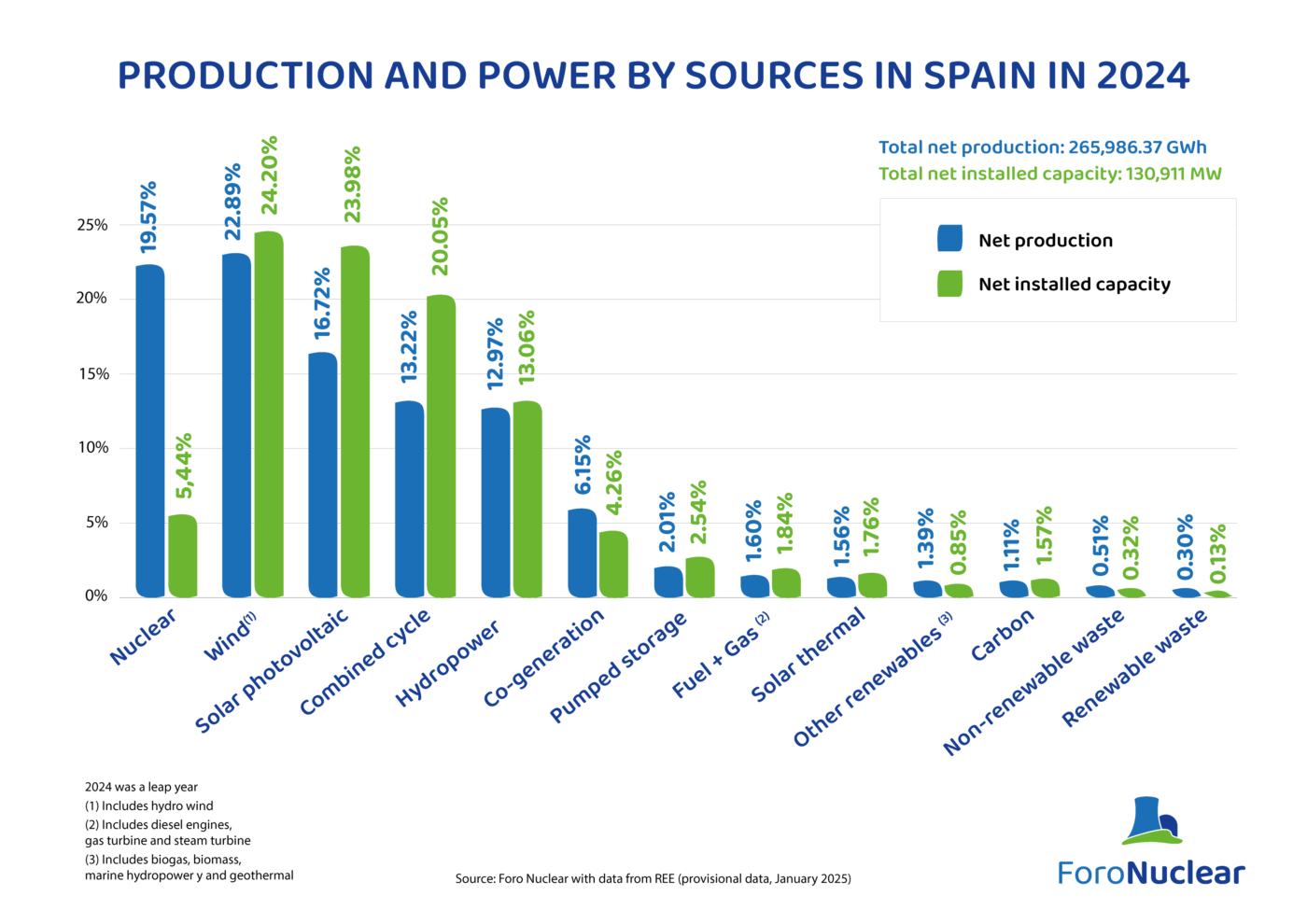
In 2024 nuclear generation was again a fundamental pillar of the electrical system, adding strength and stability
January 15, 2025- Seven operational nuclear reactors in Spain (Almaraz I & II, Ascó I & II, Cofrentes, Trillo and Vandellós I)
- Generated 19.57% of the electricity, ranking as the second-largest source of electric production
- Led the way in equivalent full-power operating hours, exceeding 83% of the year's total hours
- Produced 25.8% of the total electricity without CO2 emissions
Last year Spanish nuclear power plants generated a net total of 52,055.26 GWh, 19.57% of the country's total net electricity production. With a net installed capacity of 7,117 MW —significantly lower than that of other technologies and accounting for only 5.44% of the total— nuclear energy ranked as the second-largest source of electricity production in Spain, according to provisional data from Red Eléctrica analyzed by Foro Nuclear.
Nuclear energy once again ranks as the technology with the highest equivalent full-power operating hours, specifically 83.27% of the total hours
Once again, nuclear energy was the technology with the highest equivalent full-power operating hours, specifically 83.27% of the total hours. In 2024, nuclear plants generated electricity for 7,314 hours out of the year’s 8,784 hours. “This constant production reflects the guarantee of supply offered by nuclear energy day after day and year after year,” stated Ignacio Araluce, president of Foro Nuclear. “The electrical system needs stable baseload sources with consistent production, like nuclear, which provides stability, robustness, and firm capacity to the grid, regardless of external conditions,” he added.
Nuclear energy, a CO2-free source
In addition, nuclear power accounted for 25.28% of Spain’s CO2-free electricity generation in 2024, making it a strategic component in the decarbonization process. "Therefore, it is difficult to understand why Spain would choose to phase out one of the electricity production sources that avoids the most emissions," said the president of Foro Nuclear.
“The world is clear on this, and governments of different political orientations are embracing nuclear energy by extending the life of their reactors and building new units. Most countries with nuclear plants similar to those in Spain have decided to operate them long-term, as this is the optimal solution both in terms of supply security and economic competitiveness, as well as environmental challenges. Yet in Spain, where nuclear energy’s contribution is highly significant, a decision has been made to completely abandon it,” Araluce noted.
Most countries with nuclear power plants similar to those in Spain have opted for long-term operation
"Several technical and economic analyses show that Spain needs its nuclear power plants to operate beyond the established deadlines. The nuclear sector and its professionals are prepared to operate these plants in the long term, as they are highly valuable assets not only for the electrical system and reduction of emissions but also for local communities by generating wealth and providing stable, high-quality jobs," stated Ignacio Araluce, president of Foro Nuclear. In any case, the continued operation of Spanish nuclear power plants will have to be inextricably linked to a reduction in the disproportionate tax burden they bear, which has increased by more than 70% over the past five years and has reached economically unsustainable levels."