


Nuclear power around the world
Nuclear power is a source of energy that guarantees electric supply, puts a stop to polluting emissions, reduces exterior energy dependence and produces constant electricity. An increasingly amount of countries agree with this and support the continuity of their nuclear power plants with authorizations to operate for 60 or even 80 years –as in the United States– and the construction of new plants.
The United States has just started to grant authorizations for their reactors to operate for 80 years
The 413 reactors currently operating in 31 countries produce around 10.5 % of the world’s electricity. According to the United Nations’ International Atomic Energy Agency (IAEA) (data from December 2025) there are 70 units in construction in 15 countries, including China, India, Egypt, Russia and South Korea.. Aware of the challenges that energy and the environment face, these countries are building new plants because they consider that nuclear energy is an essential source for the present and future of their countries.
China is the country building the most reactors in the world. It has 58 units in operation and 36 more reactors in construction. Next in the list is India with six reactors in construction, followed by Russia and Turkey with four each and South Korea with three. In 2022 Egypt started construction of its first nuclear power plant. After the United Arab Emirates in 2021, it is the second Arab country with the greatest amount of nuclear energy.

| Country | Reactors in position to operate | Reactors under construction | Reactors shut down | Electrical production of nuclear origin (TWh) | Electricity of nuclear origin (%) |
|---|---|---|---|---|---|
| Argentina | 3 | 1 | - | 10.44 | 7.4 |
| Armenia | 1 | - | 1 | 2.63 | 30.8 |
| Bangladesh | - | 2 | - | - | - |
| Belarus | 2 | 1 | - | 15.69 | 36.4 |
| Belgium | 2 | 1 | - | 14.99 | 2.3 |
| Brazil | 2 | - | 4 | 15.77 | 41.6 |
| Bulgaria | 2 | - | 4 | 16.48 | 34.6 |
| Canada | 17 | - | 8 | 81.73 | 13.4 |
| China | 58 | 36 | - | 450.85 | 4.5 |
| Czech Republic | 6 | - | - | 29.69 | 40.2 |
| Egypt | - | 4 | - | - | - |
| Finland | 5 | - | - | 31.13 | 39.1 |
| France | 57 | - | 14 | 361.70 | 67.3 |
| Hungary | 4 | - | - | 15.16 | 47.1 |
| India | 21 | 6 | - | 57.40 | 3.3 |
| Iran | 1 | 1 | - | 6.44 | 1.7 |
| Japan | 14 | 2 | 27 | 85.00 | 9.9 |
| Mexico | 2 | - | - | 11.97 | 4.8 |
| Netherlands | 1 | - | 1 | 3.38 | 2.8 |
| Pakistan | 6 | 1 | 1 | 23.15 | 16.7 |
| Romania | 2 | - | - | 10.01 | 19.8 |
| Russia | 34 | 4 | 14 | 215.52 | 18.1 |
| Slovakia | 5 | 4 | 3 | 18.38 | 60.6 |
| Slovenia | 1 | - | - | 5.55 | 35.0 |
| South Africa | 2 | - | - | 7.79 | 3.9 |
| South Korea | 26 | 3 | 2 | 188.75 | 31.7 |
| Spain | 7 | - | 3 | 52.08 | 19.9 |
| Sweden | 6 | - | 7 | 49.35 | 29.1 |
| Switzerland | 4 | - | 2 | 22.98 | 27.0 |
| Turkey | - | 4 | - | - | - |
| U.K. | 9 | 2 | 36 | 45.86 | 14.8 |
| U.S.A. | 92 | 2 | 41 | 787.44 | 19.6 |
| Ukraine | 15 | 2 | 4 | 86.20 | 55.0 |
| U.A.E. | 4 | 1 | - | 39.00 | 2.18 |
| TOTAL | 413 | 75 | 175 | 2,760.07 | 763.9 |
Nuclear power plants in operation and under construction in the world
Data from December 31 2025 / Source: PRIS-IAEA and Foro Nuclear
Nuclear energy in the European Union
In the European Union (UE), 13 of the 27 Member States have nuclear power plants. There are 103 reactors in operation, producing nearly 26% of the yearly energy consumed in the whole of the EU. Another four reactors are in Slovakia and France.
In the EU, almost one third of the electricity is nuclear in origin
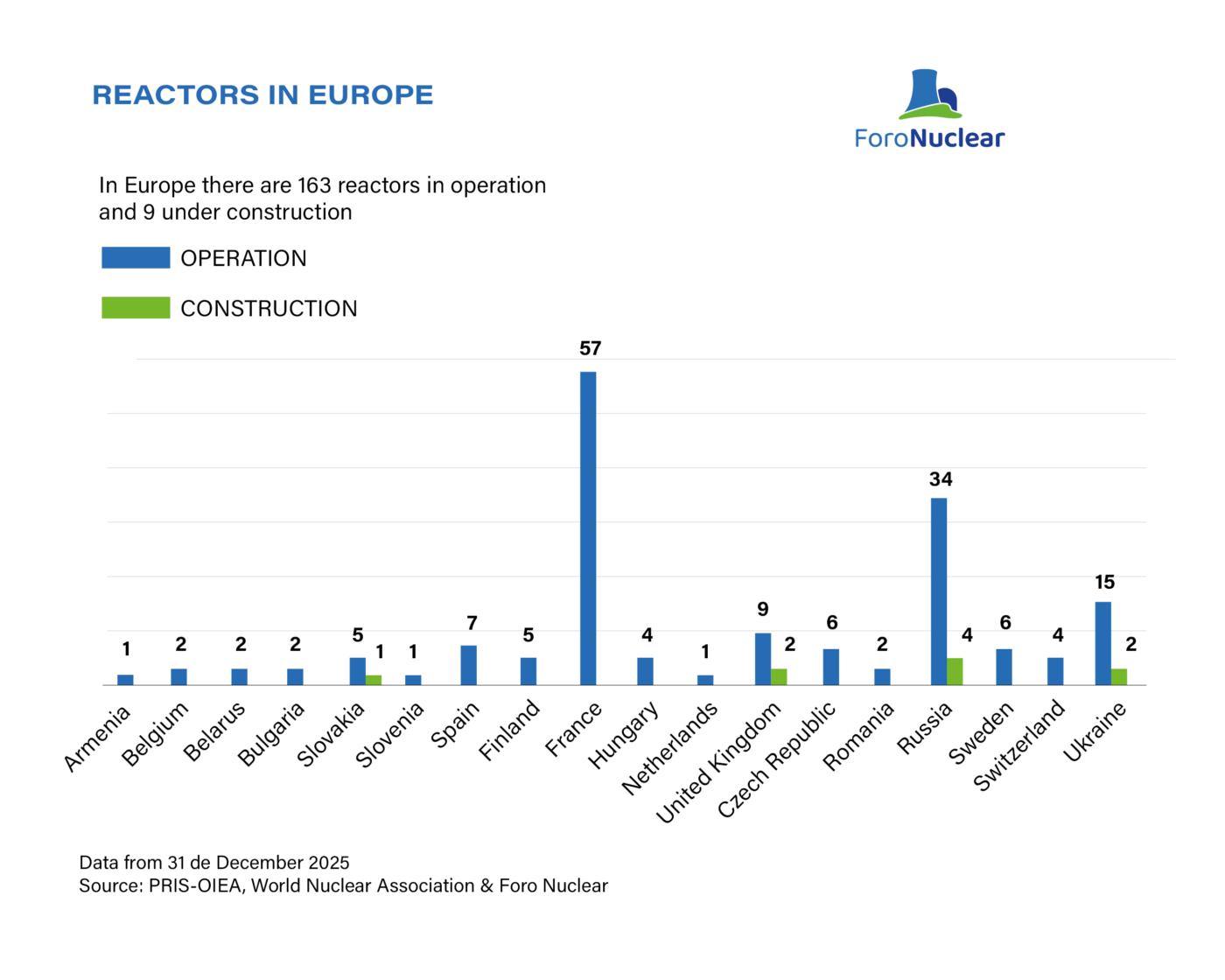
With its 57 operating reactors, France is the EU country with most nuclear units. 67% of its electricity is from nuclear sources, the greatest percentage in the world. It is followed by Ukraine with 55%, Slovakia with 52.3%, Hungary with 47.1% and Belgium with 42.2% . Almost one third of the electricity consumed in the UE comes from Nuclear Sources. There are 165 reactors in operation and 14 under construction in all of Europe-
As to the rest of continents, in Africa there are two reactors in operation and two under construction. In America there are 124 reactors in operation and two more under construction. Asia has 149 reactors in a position to operate successfully. It is the continent with the greatest support to nuclear technology, with 53 units under construction.

Continuity of operation in nuclear power plants
Continuity of operation is the operation of a nuclear power plant, maintaining its safety level, beyond the period that was initially considered in its design. This is a common practice in different countries around the world, the right strategy to comply with the basic aspects of sustainable development since it guarantees independence and diversification of energy supply whilst contributing to the fight against climate change.
Various international studies reflect that it is technically viable to operate nuclear power plants beyond their design period, maintaining the level of safety and reliability demanded by national and international legislations.
Thus, as of December 31 2025 there are 142 nuclear reactors in the world that have received authorization from different regulatory authorities to operate beyond 60 years, employing various schemes: in some cases the authorization is for 20 additional years, in others it is for a limited period and in others for an indefinite time.In the United States, where the majority of reactors have authorizations for 60-year operation, six units have received authorization to operate for 80 years. They represent over 45% of the world’s nuclear reactors.

The nuclear programs from various countries and all the nuclear sites are under the supervision and control of their local regulatory authorities as well as from the International Atomic Energy Agency (IAEA) located in Vienna (www.iaea.org). The updated list of all nuclear reactors in operation and construction for every country can be visited in this IAEA link.


