Marc Altés
President and co-founder of Econucleares“Nuclear and renewables are a perfect combination to face climate change"
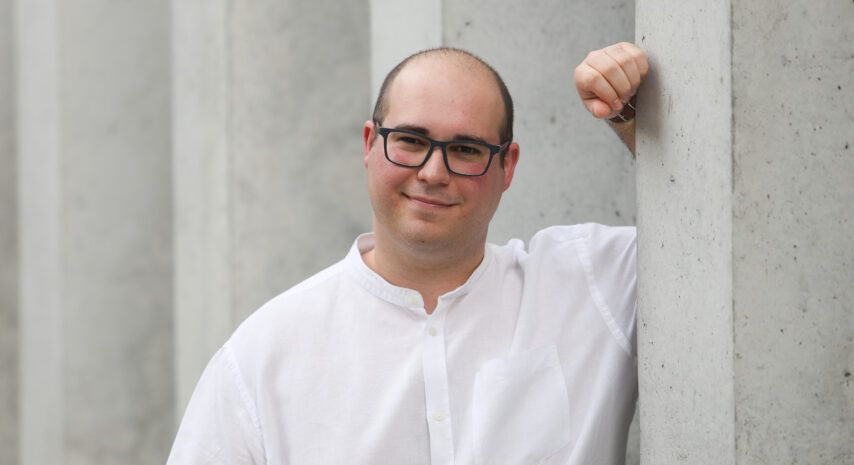
Bioengineer and nuclear engineer Marc Altés is president of Econucleares, Spain's first pro-nuclear environmental association. In this interview we explore Econucleares' vision of nuclear energy as a key solution to current environmental challenges, and their planned initiatives to promote its continuity.
What motivated you to found Econucleares?
"The data shows that nuclear energy is one of the most effective tools for decarbonizing our economy"
We are currently implementing green policies of questionable effectiveness, which in some cases are even counterproductive for the ecosystem and the development of our society. A clear example of this is the nuclear shutdown plans. The data shows that nuclear energy is one of the most effective tools for decarbonizing our economy. It is a clean, cheap, scalable and extremely stable energy source. These qualities make it complementary to renewable energies, which are intermittent by nature. In short, nuclear and renewable energies are the perfect combination to face climate change.
Did you draw inspiration from the international model of other pro-nuclear environmental associations?
Certainly. These organizations were a great source of inspiration for us. They welcomed us with open arms from the start, offering their support during our consolidation stage. This has allowed us to maintain a cordial an collaborative relationship with them, which is something that has been fundamental to our growth.
What is the impact of members of green parties supporting nucledar energy as a way to reduce emissions?
This has represented a true breakthrough from the dominant way of thinking in Europe. Nuclear energy has been historically stigmatized, especially with traditional environmentalism, which systematically rejected it. This led to the marginalization of nuclear energy both in public opinion and in political initiatives that labelled themselves environmentalists.
In Spain, for instance, nuclear energy has been reduced to a binary debate: the right supports it, whereas the left rejects it. This is extremely problematic because what should be a decision based solely on technical and scientific criteria becomes an ideological issue. Fortunately, things are changing in Europe. A decade ago the future of nuclear energy seemed bleak, but today most countries have abandoned their shutdown plans and are building or planning new nuclear power plants.
"In Europe most countries have abandoned their shutdown plans and are building or planning new nuclear power plants"
We at Econucleares are working to bring this new trend to Spain, which seems to be trapped in a bubble of inertia. We are the only country that is still moving forward with an active nuclear shutdown program, and this leaves us isolated in a decision that goes against the direction that the rest of the world is taking.
How many members does Econucleares have currently, and what notable actions are you planing?
"We are organizing a large protest in Madrid to express our opposition to the nuclear shutdown plan"
What do you think would be the main environmental and economic consequences if the nuclear shutdown proceeds as scheduled?
The consequences would be severe. If the nuclear shutdown is carried out, part of the energy currently produced by nuclear power plants will be replaced by fossil fuels, especially natural gas in Spain's case. This is because renewable energies, which are supposed to replace nuclear, are intermittent. There will be times when wind and solar production will be insufficient. Although the government is embracing storage technologies to mitigate this intermittency, the reality is that we lack the necessary technical and economic resources to achieve a 100% renewable energy grid. Additionally, if we consider that electricity demand will increase due to our need to decarbonize sectors like transportation and heating, the situation becomes even more complex.
“We lack the necessary technical and economic resources to achieve a 100% renewable energy grid”
How does Econucleares fight the lack of knowledge on this technology?
We are aware that our biggest challenge is precisely the lack of information. To address this, we developed several outreach strategies. We use social media to communicate basic concepts about nuclear energy to the public in a simple and engaging way.
Recently, we organized an initiative where three popular science YouTubers visited a Spanish nuclear power plant. For the first time in the country’s history, Aythami Soto (@Pontebata), Jordi Pereyra (@CienciaDeSofa), and Luis Horas will show on their channels what a nuclear power plant in operation looks like and how it works.
In March 2024, you organized the first demonstration in Barcelona against the nuclear shutdown. What were the results?
The very fact of carrying out the first demonstration against the nuclear shutdown in Spain's history is already a great achievement. This protest gave us visibility in national and international media. Nowadays, if you search for information about the pro-nuclear movement on the Internet, our demonstration in Barcelona is one of the first results you get.
In addition to the media coverage, this action provided us with the necessary experience to organize future mobilizations more efficiently and effectively.
In addition to presiding over Econucleares, you work as a nuclear engineer at IDOM, a consulting and engineering firm. Generally speaking, what does your job entail?
My work at IDOM focuses on projects related to radioactive waste management and the decommissioning of nuclear facilities. It might seem paradoxical that, on one hand, I am involved in dismantling nuclear plants, and on the other I preside over a pro-nuclear association, but there is no contradiction.
Waste management and decommissioning are essential parts of the nuclear industry's life cycle. I love my job because it helps ensure that nuclear energy remains a clean and safe energy source, both for the environment and society.
"Radioactive waste can be used to produce new nuclear fuel"
What would you like to add?
"The most common reaction I notice when I speak to people about nuclear power is surprise"
"Saving nuclear energy means ensuring a cleaner, more sustainable future with access to reliable, affordable, and fair energy for everyone"