Aythami Soto
Science communication and creator of the 'Reacciona Explota' and 'Ponte Bata' YouTube channels“We are giving up on nuclear power simply to satisfy slogans and political agendas”
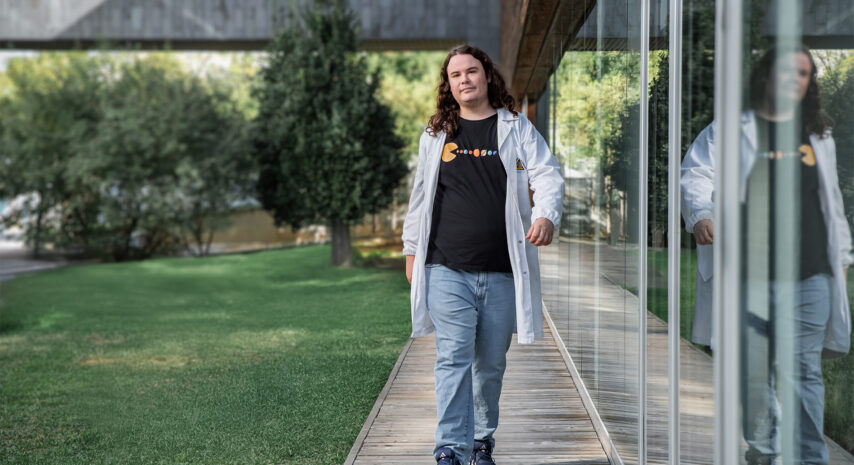
Aythami Soto has a Chemistry degree from the University of Girona and combines his scientific background with digital communication to bring chemistry closer to new audiences. He is the creator of the channels 'Reacciona explota' and 'Ponte Bata', which together have over one and a half million YouTube subscribers. Aythami has made science communication his main field of work, with a visual, educational and rigorous approach. With over ten years of dedication to spreading scientific information on social media, he states that "closing nuclear power plants will lead to more CO2 emissions, higher electricity prices and greater dependence on third parties."
You studied to be a chemist and later a researcher in science communication. At what point did you realize that science communication could be a viable professional path to bring science closer to society?
I started this as part of the final project for my Chemistry degree, when we noticed a clear lack in science communication in Spanish. It was only in recent years that it shifted from being a hobby to becoming my livelihood, especially following the surge in views and subscribers during the 2020 pandemic.
Today, we have become one of the leading Spanish-language references in chemistry and, almost unintentionally, also in nuclear energy.
Since creating the channels 'Reacciona Explota' and 'Ponte Bata', you have managed to connect with very diverse audiences, especially young people. What goals do you pursue with this work, and how has your approach to science communication evolved in recent years?
The goal of the channels has always been to entertain while presenting concepts or stories that place major scientific discoveries—such as radioactivity, X-rays or radium—into context.
Our initial approach was more direct and focused on experiments, but over the years we have discovered that storytelling is key. We have gradually evolved toward a more narrative, documentary-style approach.
In a context of energy transition and social debate around sources such as nuclear power, what role does science communication play in building a critical and technically informed culture?
Science communication is the bridge between data and decision-making. At a time of energy transition, when legitimate doubts coexist with oversimplified—and even malicious—narratives, its role is to provide context, translate technical concepts and, above all, offer comparable metrics.
“Science communication is the bridge between data and decision-making”
Science communication is not about promoting any particular technology; it is about equipping people with the tools they need to evaluate risks and benefits with sound judgment. If we manage to help a teenager, an industry worker or a public decision-maker better understand the figures, the stories and the people behind the headlines, then we are building a critical and technically informed energy culture.
Would you say there still is a certain "chemophobia" or "nucleophobia" in popular culture?
I would say yes... but with nuances. Rather than "hatred of chemistry" or "fear of nuclear energy," what persists is a distorted perception of risk.

There is a certain negativity bias and some confusion between presence and danger: if something "sounds chemical" or "radioactive," we assume it is harmful without asking about dose, route of exposure or context.
In chemistry, this is something we are more than used to, as it is often overlooked that risk depends on the dose and on how and for what purpose compounds are used. For example, there are "artificial substances" such as chlorine that are portrayed as toxic and dangerous, when in reality they make water drinkable and are a cornerstone in the production of many of the comforts of everyday life, while so-called "natural" compounds can be extremely toxic.
When it comes to nuclear energy, people tend to recall the impact of Chernobyl or Fukushima before thinking of X-rays, radiotherapy or electricity generation. I believe that the best way to counter this perception is precisely through visual storytelling, data and historical context.
In 2024 you visited the Vandellós II nuclear power plant along with other science communicators, and described the experience as "one of the most incredible adventures of our lives." What surprised you most about this visit, and how did it influence your perception of nuclear energy?
I would like to express my deep gratitude to the team at the Ascó-Vandellós Nuclear Association (ANAV), for having the courage to open the doors of Vandellós II to a group of science communicators.
"The experience of visiting Vandellós II was incredible because we witnessed the safety measures and protocols in place, as well as the immense human factor"
The visit was an incredible experience. We not only witnessed the safety measures and protocols behind an industry of this scale, but also the immense human factor: the number of professionals working every day in the nuclear field to ensure that we can have electricity at home and charge our devices.
What stayed with me most from that visit were the conversations with the turbine and reactor operators who accompanied us throughout the tour. It was a pleasure to listen to such highly skilled professionals. I also greatly enjoyed the visit to the spent fuel pool, as that is where you truly grasp the power hidden within uranium.
After this visit, what aspects did you share on your social media, and what was the impact on your followers?
We shared the entire visit, excluding those aspects that could not be shown for reasons of physical security, and then we posted a couple of short videos about the plant and uranium as fuel.
"The response to the video of our visit to the Vandellós II nuclear power plant was overwhemingly positive"
The impact was fantastic. Both videos reached over five million views. Honestly, I was expecting some negative backlash, but the reception from my audience was overwhelmingly positive. I read several comments saying that the video had helped them change their perspective on this type of power plant.
From your perspective as science communicator, what is your opinion on how science is taught in Spain's education system? Do you think it is lacking a more visual or experimental approach?
I can only speak for what concerns chemistry, but yes, I do think that in this country we need to rethink, at least slightly, how the subject is taught. Chemistry is a science that studies change and was born among flasks and beakers; it is not something that can be taught exclusively from a theoretical framework. I fell in love with chemistry as a child because I had the opportunity to carry out experiments at home that complemented very well what I was learning in the classroom.
"In the digital era, if you don't tell your own story other people will do it for you"
From your experience as a young science communicator with a strong digital presence, what advice wouuld you give to the nuclear sector regarding outreach and communication with society??
I say this with the best of intentions, but I think the sector's greatest sin has been to be overly secretive. From my perspective, I would say that its strategy has been to behave like an ostrich: minimize public exposure and hope the issue "doesn't make headlines," and that when they talk about it it is not negatively but not positively either. This no longer works: in the digital era, if you do not tell your own story, others will do it for you."
"I would encourage the nuclear sector to do more educational dissemination externally, not just within its own circles"
I would encourage the nuclear sector to do more educational dissemination externally, not just within its own circles. It is not enough to speak only to engineers and regulators; this field needs to reach out to students, teachers, journalists and especially the general public, using formats that are native to the Internet.
A good example is ANAV's approach: opening doors, facilitating filming and allowing science communicators to come in, ask questions and transparently explain the process. This kind of access builds trust because it transforms nuclear energy from something opaque into something understandable, measurable and visible.
Another particularly noteworthy case if Alfredo García, known as Operador Nuclear. His outreach work has been crucial in changing public perception regarding this type of energy.
What role do you think science content creators can play in public decision-making related to technology, energy or sustainability?
We can definitely make decision-making easier: we translate technical content into clear language and provide numbers and simple comparisons to understand pros and cons transparently. This reduces polarization, raises the quality of the debate and allows more people to form opinions based on evidence. Our role is not to make politics with science, but to make science understandable and verifiable—always with editorial independence and transparency regarding funding.
"Our role as science communicators is not to politize science, but to make it understandable and verifiable"
Back to the nuclear issue, what is your opinion on the shutdown of Spanish nuclear power plants?
Honestly, it is a real shame. We have a source of electricity generation that, together with renewables, helps us fight climate change, and we are giving it up simply to satisfy political slogans and agendas. The irony is that this is done in the name of a green energy transition when we know that the gap will be filled by gas, which will mean more CO2 emissions, higher electricity prices and greater dependence on third-party countries.
Moreover, it leaves many people and much of the industrial sector behind: highly skilled jobs in operation and maintenance, local suppliers, industrial ecosystems, and decades of accumulated knowledge. Without a credible technical and social plan, we are not only giving up a stable energy source but also decapitalizing talent and pushing part of the sector into inactivity or emigration, precisely at a time when we most need capacity and experience for the energy transition.
“Lack of understanding is one of the greatest enemies of this field”
Would you like to add anything?
The great Marie Sklodowska-Curie once said, "Now is the time to understand more, so that we may fear less." Lack of understanding is one of the greatest enemies of this field. If it is to survive, it must wake up and begin to reclaim its image and the positive impact it has on society. Science communicators such as Operador Nuclear, Marc Altés, myself and others can help make this possible—but the industry also needs to open up.