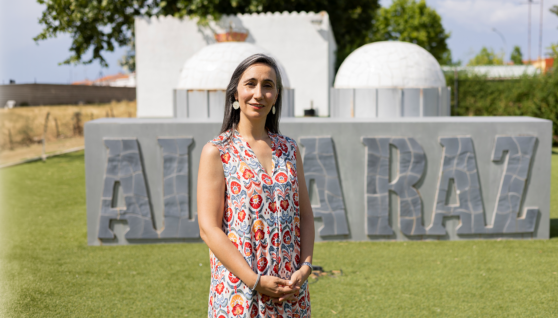
Ana Rodrigues
Campaigns Lead for the environmental organisation WePlanet in Spain“We support renewables alongside nuclear because both are essential”
Ana Rodrigues joined WePlanet to lead and develop the organisation’s strategy in Spain, particularly in key areas such as nuclear energy and alternative proteins. As a lawyer specialising in international law and human rights, she has worked throughout her career with various international organisations in fields including human rights, environmental protection and international governance.
In this interview with Foro Nuclear, she stresses that “nuclear energy is one of the safest ways to generate electricity, and an essential tool for tackling climate change. This is one of the greatest challenges facing humanity, and we cannot afford to dismiss effective solutions simply because they challenge beliefs that have been entrenched for decades.”
What are WePlanet’s objectives?
WePlanet is a network of citizen-led organisations across Europe, Africa and Asia that promotes solutions grounded in scientific evidence to address the greatest challenges of our time: climate change, the loss of biodiversity and global poverty. Our mission is to protect and restore nature while improving people’s well-being through innovation and the development of public policies based on verifiable evidence.
We believe that environmental protection and economic development are not opposing goals. By embracing technologies such as nuclear energy, advanced biotechnology, precision agriculture and novel proteins, we can reduce humanity’s environmental footprint while ensuring that everyone has access to clean energy, nutritious food and greater opportunities. Rather than asking society to consume less or sacrifice its well-being, we believe we should harness the best scientific and technological advances available to achieve more for both people and the planet.
“Technologies such as nuclear energy help reduce humanity’s environmental footprint”
In the energy sector, one of our main objectives is to accelerate the phase-out of fossil fuels while ensuring energy security and affordable electricity. We support renewables alongside nuclear because both are essential to building a reliable, low-carbon electricity system. Existing nuclear power plants provide large amounts of clean electricity with very low emissions throughout their entire life cycle. Extending their operating lifetimes is one of the fastest and most cost-effective ways to reduce emissions while maintaining a stable electricity supply.
“The continuity of nuclear power plants is one of the fastest and most cost-effective ways to reduce emissions”
How does your approach differ from more traditional environmentalism?
WePlanet represents a forward-looking vision of environmentalism that understands that human progress and environmental protection reinforce one another. We believe it is possible to restore nature while improving people’s lives through science, innovation and technology.
This means advancing novel proteins to reduce pressure on farmland, reduce emissions from livestock farming, create more space for ecosystem restoration and rewilding, and accelerate the deployment of clean energy, including both renewables and nuclear.
“It is possible to restore nature while improving people’s lives through science, innovation and technology”
We also believe that sustainable development should benefit everyone and facilitate access to modern energy, food security and economic opportunities, particularly in the global South.
Our approach is based on ecomodernism, which recognises that technological innovation has enabled humanity to continually reduce its environmental impact while improving living standards. Rather than assessing solutions through an ideological lens, we support those backed by robust scientific evidence. This means embracing nuclear energy alongside renewables, crop improvement alongside nature conservation, and cultivated meat alongside more sustainable farming practices.
“At WePlanet, we support solutions backed by robust scientific evidence”
How long has your organisation been active in Spain, and what are its main goals here?
WePlanet has been active in Spain since 2025, although many of our members were already actively involved in European debates on energy and environmental policy.
We believe that the decision to shut down Spain’s nuclear reactors is a mistake, and our main goal in Spain is to reverse it. Without nuclear energy, Spain will have to rely more frequently on natural gas when wind and solar generation are insufficient. This would mean higher emissions, greater volatility in electricity prices and slower progress towards meeting its climate targets.

What has changed to move environmental voices such as WePlanet to speak out in support of nuclear energy?
The climate crisis has profoundly changed the energy debate. As countries move towards climate neutrality, it has become increasingly clear that decarbonising electricity systems requires not only renewables, but also reliable, low-carbon energy sources capable of generating electricity regardless of weather conditions.
At the same time, many preconceptions about nuclear energy have been reassessed. Decades of operational experience, major advances in safety and growing concern about energy security have led many environmentalists to reconsider their previous positions.
“International organisations recognise that nuclear energy has an important role to play in achieving deep decarbonisation”
International organisations such as the International Energy Agency (IEA) and the Intergovernmental Panel on Climate Change (IPCC) consistently systematically recognise that nuclear energy can play an important role in achieving deep decarbonisation. A growing number of voices within the environmental movement acknowledge that excluding one of the world’s largest sources of clean electricity makes climate targets harder and more costly to achieve.
Nuclear energy also has one of the best safety records of any major energy source. According to data compiled by Our World in Data, nuclear energy causes around 0.03 deaths per terawatt-hour of electricity generated—approximately 99.8% fewer than coal and 97.6% fewer than gas. These figures already include deaths related to the Chernobyl and Fukushima accidents. By comparison, coal causes approximately 25 deaths per terawatt-hour and oil around 18, mainly because of air pollution.
Decades of operational experience, continuous improvement and strict regulation have made nuclear energy one of the safest options ever developed for producing large quantities of clean electricity.
“Decades of operational experience, continuous improvement and strict regulation have made nuclear energy one of the safest options”
Do you find resistance or criticism from other environmental groups or sectors?
Nuclear energy has been one of the most divisive issues within the environmental movement for decades, so we do face criticism from some organisations. However, we do not see disagreement as something to be avoided. We believe it should be an opportunity for open, evidence-based debate.
One example is our Dear Greenpeace campaign. When Greenpeace challenged the European Union’s decision to recognise nuclear energy as a sustainable investment under the EU's green taxonomy, we publicly opposed that initiative because we believed it ran counter to scientific evidence and Europe’s climate goals. Our message was simple: if the IPCC, the International Energy Agency and many of the world’s leading climate scientists recognise that nuclear energy has an important role to play in achieving net-zero emissions, environmental organisations should be willing to consider that evidence rather than dismiss it.
At WePlanet, we are always willing to engage with those who disagree with our position. We do not expect everyone to reach the same conclusions, but we believe the debate must begin with the best available evidence, not ideological positions. Climate change is far too urgent a challenge to reject effective solutions simply because they challenge long-held beliefs.
We also believe that this conversation must incorporate a social justice perspective. The energy transition must not only reduce emissions, but also guarantee a reliable and affordable electricity supply. Maintaining the operation of existing nuclear power plants that meet safety requirements helps strengthen energy security, protect jobs and ease pressure on electricity prices.
Do you believe the position of the general environmental movement regarding this technology is changing internationally? Why?
Yes, I believe there has been a profound shift over the past decade. Climate change has completely transformed the debate. As the urgency of decarbonisation has become more apparent, many environmentalists have begun to ask a different question: not “Which technologies do we like?” but “Which technologies actually help us reduce emissions as quickly as possible?”
This change in perspective has led many people to reconsider nuclear energy. Today, organisations such as the IPCC and the IEA recognise that nuclear energy can play an important role in achieving deep decarbonisation. Governments that had previously planned to phase out nuclear energy are extending the operating lifetimes of their reactors or investing in new projects because they acknowledge the value of a firm, low-carbon source of electricity in ensuring energy security and meeting climate targets.
“Climate change is far too urgent a challenge to reject effective solutions such as nuclear energy”
We have also seen a new generation of environmentalists emerge. Young climate advocates are often less tied to the ideological debates of previous decades and more interested in evidence-based solutions. They understand that the real problem is not nuclear energy, but fossil fuels.
“Young climate advocates understand that the problem is not nuclear energy but fossil fuels”
The environmental movement itself is also becoming more diverse. Although some organisations remain opposed to nuclear energy, a growing number of scientists, conservationists and climate advocates support a more pragmatic approach that combines renewables, nuclear energy, energy storage and other clean technologies. At WePlanet, we are proud to be part of that evolution. We believe environmentalism should never be tied to an ideology; it must evolve as scientific knowledge evolves.
WePlanet recently called for a review of Spain’s nuclear phase-out timetable. What technical grounds support this request?
Our call to review the timetable for closing Spain’s nuclear power plants is based on evidence from climate science, energy systems analysis and economics. The central argument is simple: shutting down existing nuclear power plants before equivalent clean and reliable alternatives are available would make decarbonisation more difficult, more costly and less secure.
“Without nuclear energy, decarbonisation will be more difficult, more costly and less secure”
Spain’s nuclear fleet currently generates around 20% of the country’s electricity and almost one-third of all its low-carbon electricity. These plants produce electricity with very low greenhouse gas emissions across their entire life cycle, while also providing firm, dispatchable generation that complements renewable sources. As electricity demand rises due to the electrification of transport, industry and heating, maintaining existing nuclear capacity helps ensure system reliability while reducing dependence on fossil fuels.
The IEA has repeatedly concluded that extending the operating lifetimes of existing nuclear reactors is one of the most cost-effective ways to reduce emissions. Prematurely replacing that generating capacity would require very substantial additional investment in new generation, storage and grid infrastructure, while increasing the likelihood of reliance on natural gas during periods when renewable generation is insufficient.
There is also an important economic dimension. Independent studies estimate that phasing out nuclear energy could raise electricity prices by around 23% for households and 35% for businesses, reducing industrial competitiveness and increasing pressure on consumers. At the same time, nuclear power plants support thousands of highly skilled jobs and serve as an economic engine for many regions.
“Nuclear power plants support thousands of highly skilled jobs and serve as an economic engine for many regions”
Our manifesto is not opposed to renewable energy—quite the contrary. We strongly support the expansion of wind, solar and energy storage. Our argument is that the fastest and most resilient path to net-zero emissions is to combine renewables with existing nuclear energy. If Spain’s reactors continue to meet all the safety requirements established by the nuclear regulator, extending their operation is a pragmatic, evidence-based decision that benefits the climate, the economy and energy security.
You emphasise the importance of a debate based on scientific evidence. Do you think this approach is sufficiently present in energy decision-making in Spain, or do you consider the debate polarised?
Spain has excellent scientists, engineers and technical institutions, so we have more than enough specialist expertise. The challenge is not a lack of knowledge, but ensuring that it occupies a central place in public debate and decision-making.
Nuclear energy is a technology around which many preconceptions have accumulated over recent decades. Events such as Chernobyl and Fukushima, together with the anti-nuclear movements of the 1970s and 1980s, have profoundly shaped public perception. As a result, many people hold very strong views about nuclear energy before they have even had the opportunity to examine the evidence.
Like any other technology, nuclear energy should be assessed based on the best available scientific evidence, not on impressions formed decades ago. Science evolves, technologies improve, and our understanding must evolve with them. That is how societies make better decisions.x
I would like to see more spaces for debate in Spain that focus less on ideological labels and more on scientific evidence. Energy policy involves complex decisions that require balancing factors such as affordability, security of supply, emissions reductions and environmental impact. Those decisions deserve rigorous analysis, not preconceived positions.
“I would like to see more spaces for debate in Spain that focus less on ideological labels and more on scientific evidence”
One of our goals at WePlanet is precisely to contribute to that conversation by bringing scientific studies, expert analysis and evidence into the public debate.
You are a lawyer specialising in international law and human rights. How does that background influence the way you approach the energy and climate debate?
My background in international law has profoundly shaped the way I understand public policy. Lawyers are trained to analyse evidence, not assumptions. In any legal proceeding, every claim must be supported by facts, and I apply the same approach when analysing energy and climate issues.
When I examined the evidence on nuclear energy—from its safety record and life-cycle emissions to its role in decarbonisation—I consistently reached the same conclusion: nuclear energy is one of the safest ways to generate electricity and an essential tool for tackling climate change.
My experience in human rights has also shaped the way I understand the energy transition. Climate policies are ultimately about people. Access to affordable, reliable electricity underpins fundamental rights such as health, education, economic opportunity and human dignity. The energy transition cannot become a luxury available only to the wealthiest people or countries.
If we have technologies capable of providing clean, reliable and affordable electricity, we should use them so that everyone can enjoy the benefits of access to energy—not only those on higher incomes.
Would you like to add anything else?
Climate change is one of the greatest challenges humanity has ever faced, and we cannot afford to dismiss effective solutions simply because they challenge beliefs that have been entrenched for decades.
Environmentalism has always evolved along with the advancement of scientific knowledge, and we believe the same must happen today. Nuclear energy is not a stand-alone solution, but together with renewables, modern electricity grids, energy storage and other clean technologies, it is an essential part of a realistic path towards a net-zero future.
I would also like to thank Foro Nuclear for providing this opportunity to discuss an issue that is so important to Spain’s energy and climate future. At WePlanet, we will continue working to promote an open, respectful and science-based debate, in the conviction that the best way to tackle climate change is to remain open to every solution that can help build a cleaner, safer and more prosperous future. We look forward to continuing to work with all organisations and individuals who share that common goal.