Uranium 2026: there are enough resources to meet future demand
The OECD Nuclear Energy Agency and the United Nations International Atomic Energy Agency have published the 31st edition of Uranium 2026: Resources, Production and Demand. This report concludes that the global uranium industry is responding to growing interest in developing new nuclear capacity, and that expenditure on exploration and mine development has significantly increased to meet future demand.
Continued growth of global nuclear capacity
This new edition covers 2023 and 2024, and includes selected information from 2025 and 2026.
As of January 1st 2025, there were 418 nuclear reactors in commercial operation worldwide, with a combined net installed capacity of 378 GWe and annual uranium requirements of approximately 64,500 tonnes. In view of growing electricity demand and the need to strengthen energy security and advance environmental goals, global nuclear capacity is projected to increase substantially by 2050: the low-growth scenario points to a 42% growth, and the high-growth scenario would be more than double. Annual uranium requirements would therefore rise to between 84,800 and 143,900 tonnes.
Depending on the scenario, global nuclear capacity could grow by 42% or more than double by 2050
Uranium 2026 analyzes exploration, resources and production in the global uranium market. Based on 46 national reports, most of which draw on official government data, it presents projections for nuclear capacity and reactor uranium requirements up to 2050. It also assesses long-term supply-and-demand trends.
Investment is necessary to turn resources into supply
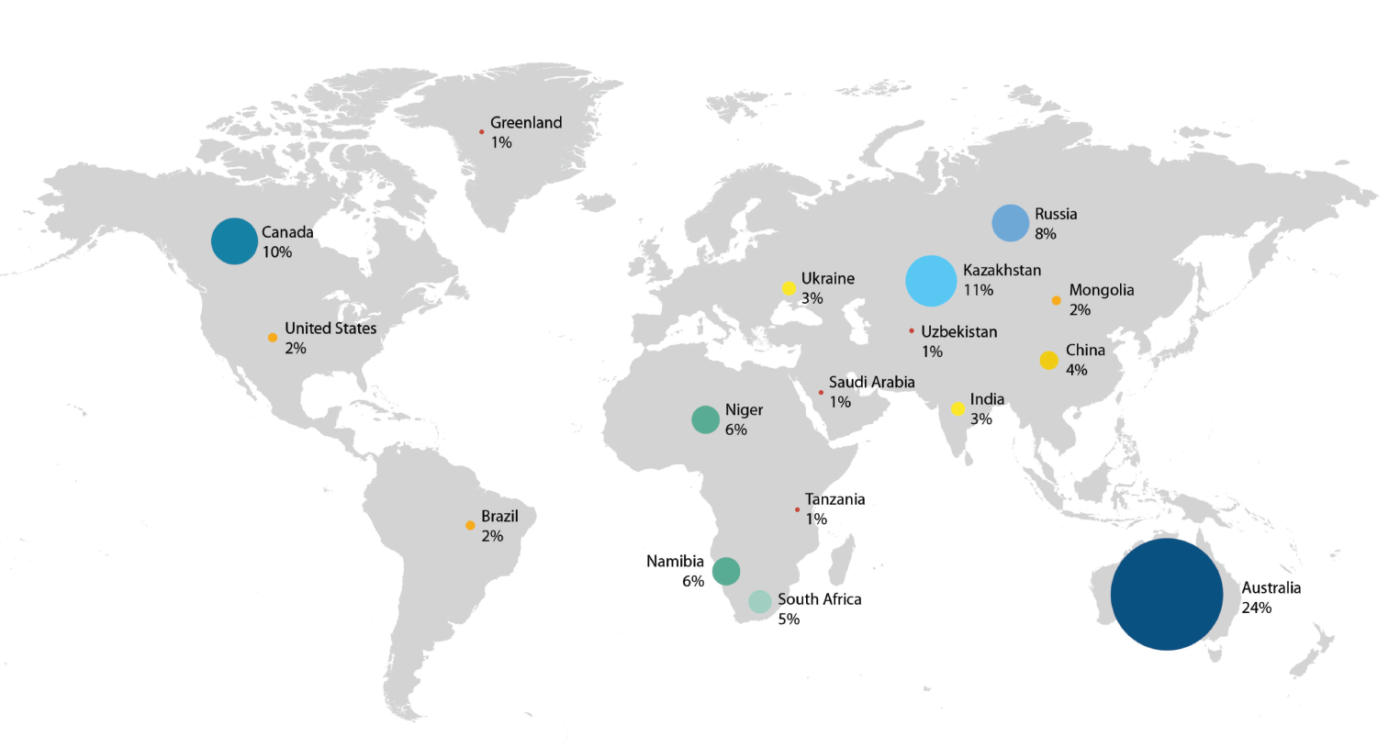
The report estimates global recoverable uranium resources at costs below USD 260/kgU (USD 100/lb U₃O₈) at more than 8.1 million tonnes. This represents a 2.1% increase compared with the 2024 edition and would be sufficient to meet even the highest projected demand through to 2050.
Identified global uranium resources would be sufficient to meet even the highest nuclear demand scenario up to 2050
However, the availability of resources does not guarantee security of supply in itself: turning these resources into production requires substantial and sustained investment.
Given that uranium mining projects typically take 15 to 20 years to develop, it is essential to identify, license and advance new projects in the short and medium term to reduce the risk of future supply constraints and disruptions. Adequate and sustained prices, supported by long-term contracts, are crucial to maintaining exploration, enabling final investment decisions on new mines and accelerating innovation in resource extraction, processing and recovery techniques.
Production and exploration are increasing, but new projects need to move forward
Recent production trends point to a strengthening of supply. Global uranium production increased by around 20% in 2023 and 2024 compared with the previous two years, exceeding 116,000 tonnes. In 2024 alone, it reached 61,924 tonnes, the highest figure since 2016. Uranium 2026 expects this upward trend to continue in the short and medium term.
The increase was mainly driven by the restart of inactive capacity and the expansion of existing mines, particularly in Canada. Although several projects received regulatory approvals and progressed in their development, none of the new projects has yet begun producing uranium.
Global uranium production grew by around 20% in 2023 and 2024, but no new mining project has yet begun production
Global expenditure on exploration and development exceeded USD 1.78 billion in 2023–2024, around 46% more than in 2021–2022. Although exploration drilling increased significantly, drilling specifically aimed at project development remained relatively stagnant, highlighting the need to strengthen the pipeline of projects under development.