What is an atom?
Atoms are the smallest particles into which a chemical element can be divided while still retaining its chemical properties. They are the basic structural units of matter.
Everything is made up of atoms, the basic structural units of matter
Particles so small they are invisible
Atoms are extremely small particles — the smallest units into which an element can be divided while still retaining its chemical properties. Ancient Greeks believed atoms were the smallest particles that could exist; in fact, the word “atom” comes from the Greek term meaning “indivisible.” A single human hair has a thickness equivalent to about 500,000 carbon atoms stacked on top of one another.
Atoms cannot be seen with the naked eye, nor even with an ordinary microscope. They are too small to deflect waves of visible light, which means they cannot be observed with optical microscopes. However, atoms can be observed using electron microscopes, which emit waves of electrons capable of interacting with them.
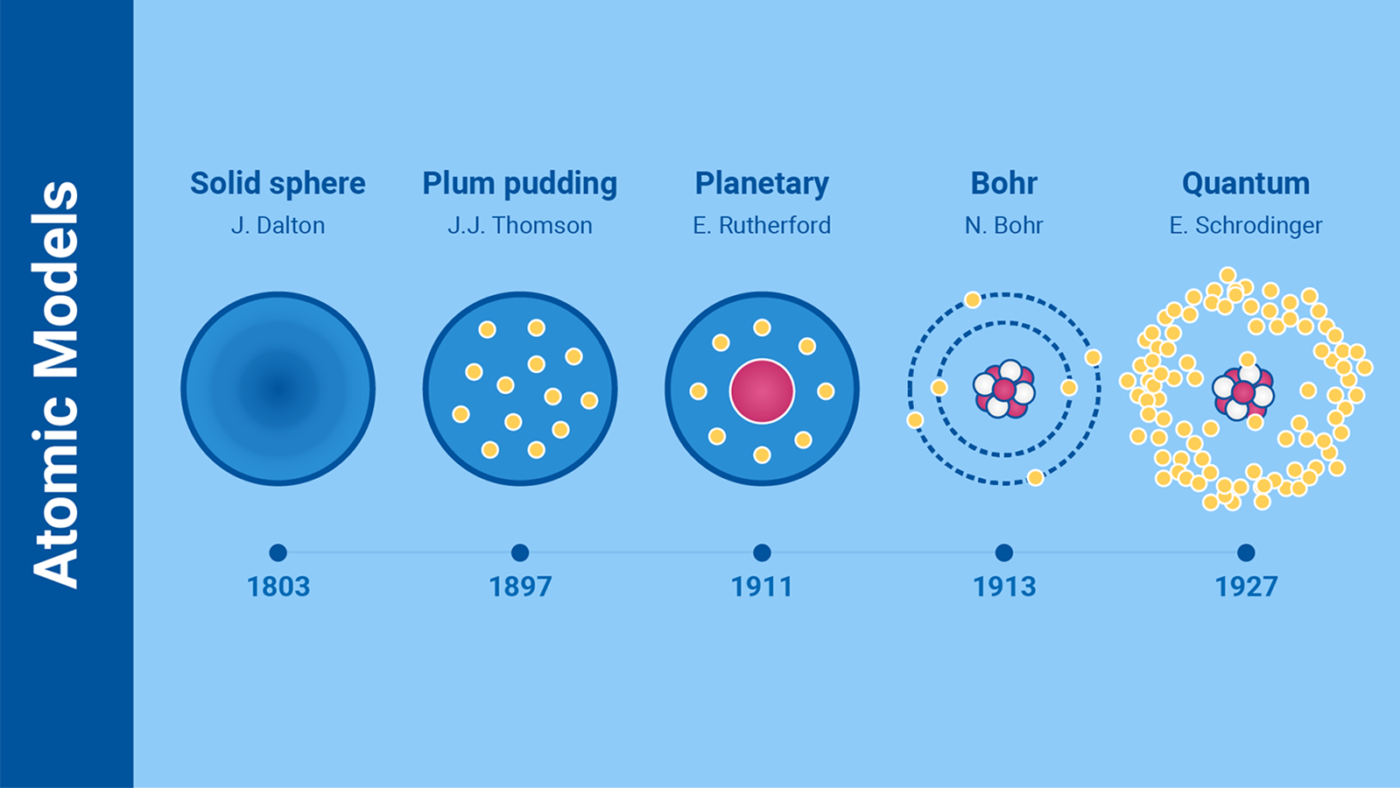
The composition and structure of the atom
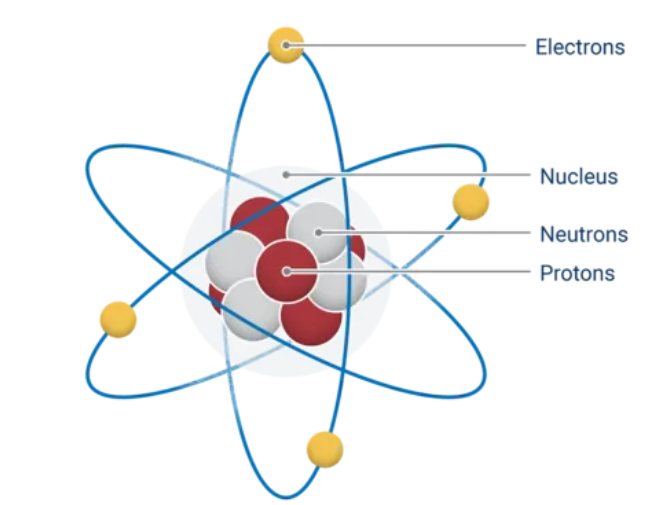
Each atom is made up of three types of particles: protons, neutrons, and electrons. At its center is a dense nucleus that contains protons and neutrons and is much smaller than the atom as a whole. To give an idea of the scale, if the nucleus were the size of a marble, the entire atom would be comparable in size to a sports stadium.
Protons carry a positive charge, electrons carry a negative charge, and neutrons are electrically neutral. The nucleus is held together by the nuclear force, which acts over very short distances, similar to the size of the nucleus. At these distances, it is much stronger than the electrical repulsion between protons (which, having the same charge, would tend to push them apart), but its strength decreases rapidly with distance.
The number of protons in the nucleus determines the chemical element: for example, atoms with one proton are hydrogen, while those with eight protons are oxygen.
Surrounding the nucleus is a cloud of electrons. Electrons and the nucleus are bound together by the Coulomb force, which describes the attraction between opposite electric charges. If an electron gains enough energy, it can detach from the atom, leaving the atom with a positive charge.
Atoms have three types of particles: protons, neutrons and electrons, with positive, negative and neutral charges, respectively
What are ions?
Atoms that have the same number of negatively charged electrons and positively charged protons are neutral, since the charges cancel each other. If an atom gains or loses electrons, it becomes a cation (positively charged ion) or an anion (negatively charged ion)

Although neutral atoms have a weak electric field, charged (“ionized”) atoms have a strong electric field and are strongly attracted to ions and molecules with the opposite charge. Atoms can become ionized through collisions with other atoms, ions, or subatomic particles, or through exposure to gamma radiation or X-rays.
Ionizing radiation is radiation that has enough energy to remove an electron from an atom. This process can also alter the chemical structure of matter, as occurs, for example, with radiation-induced damage to DNA in living tissues.
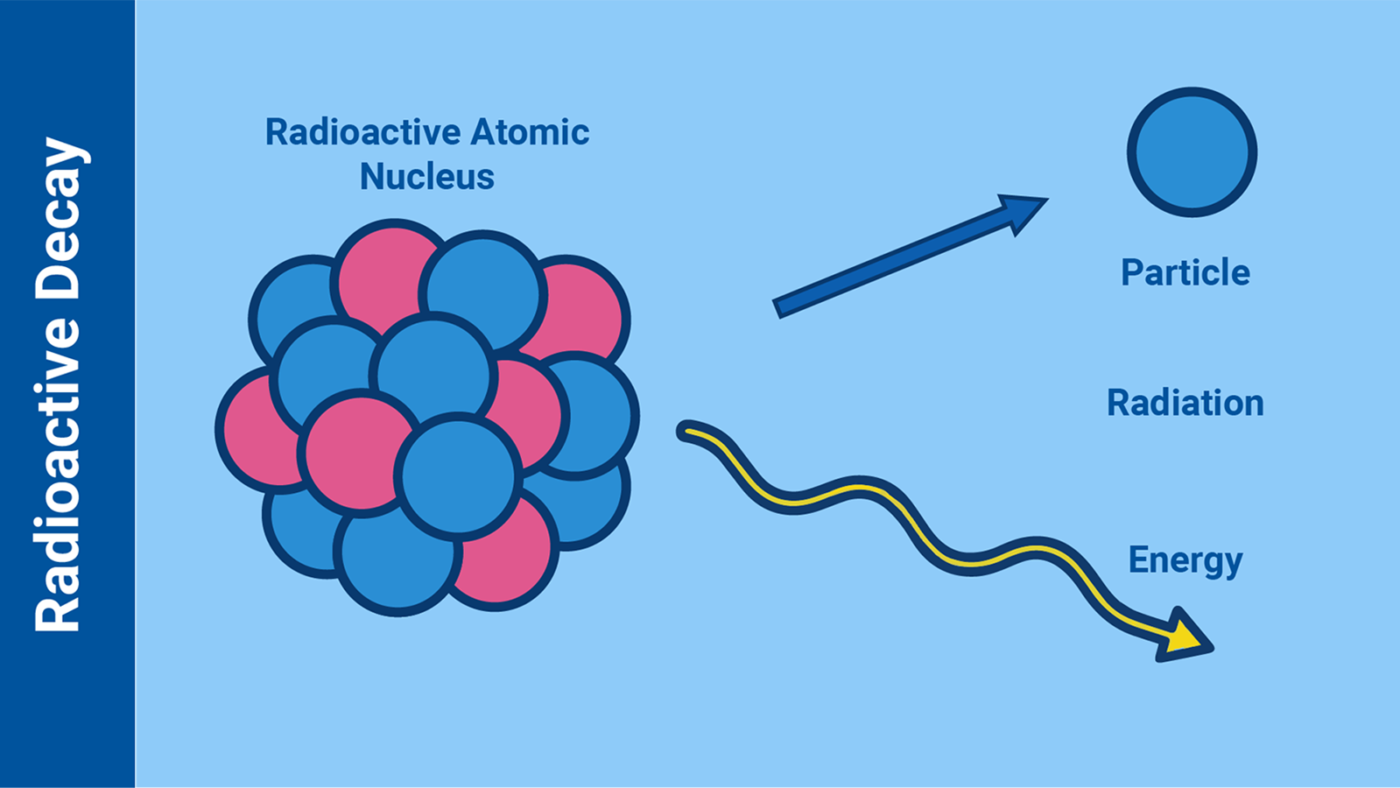
Radiation
Most atoms on planet Earth are stable, mainly because their nuclei contain a balanced composition of particles (neutrons and protons).
However, in certain types of unstable atoms, the number of protons and neutrons in the nucleus prevents the particles from remaining bound together. In such cases, the atoms “decay” and release energy in the form of radiation (for example, alpha particles, beta particles, gamma rays, or neutrons). When harnessed safely, this radiation can be used for various beneficial purposes (such as gamma rays, X-rays, or materials for nuclear power plants, among others).
Source: IAEA