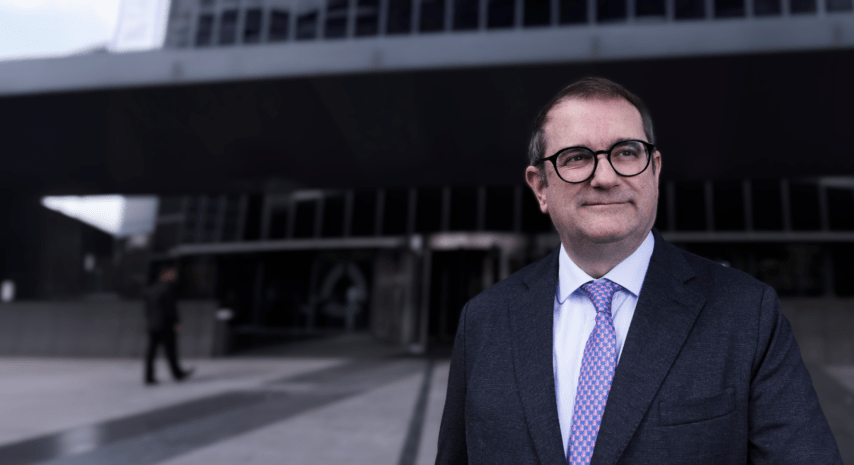
Manuel Vila
CEO of Newtesol"Shutting down nuclear power plants is an outrage and a lack of strategic vision"
Newtesol is a company from Cantabria, Spain, that manufactures nuclear components and equipment under 50 tons of weight. It has been granted the leading international certifications and is present in nuclear power plants around the world. Its CEO, Manuel Vila, states in this interview that “nuclear power generation is a strategic asset that Spain must preserve by extending the life of operating plants.” In his opinion, “having nuclear energy is a strategic, ecological, economic, and technological imperative.”
You have developed your career in the industrial sector. How did you get started, and what led you to specialize in the nuclear field?
After graduating, I worked in a family-owned company that manufactured equipment for the naval and petrochemical sectors. There, I held various positions in the technical department, production, and commercial area before being appointed general manager. Later, I led the Spanish branch of a French multinational group that combined the oil & gas sector with the nuclear sector, to which it supplied heating components. My definitive “immersion” in the nuclear field took place when I joined Newtesol eight years ago.
What advice would you give to engineering students who want to pursue a career in the nuclear sector?
I would give the same advice to any engineering student: work hard. First, to finish their studies, and then, once they are working, to eagerly learn as much as possible. The future belongs to those who want to work and enjoy working.
Now, if they are drawn to the nuclear sector, and assuming they already speak English fluently, I would suggest they learn French and consider (or at least not rule out) training or working in France for a while to absorb the country's knowledge, nuclear mindset, and even national pride—so they can bring those values back home.
You've managed both family-run and multinational companies before leading Newtesol. What key lessons do you apply today as CEO?
A family business always takes a long-term view, conveys that vision to its members and, when times are hard, knows how to tighten its belt to pass the storm trying to protect its entire ecosystem as much as possible. A multinational, on the other hand (except at the highest strategic levels), often doesn’t look beyond the fiscal year (which might be considered mid-term), shortens its “long term” to the implementation period of a business plan, and managerial attention is focused on quarterly results. If things go south it resorts to making drastic cuts, since big decisions often don’t take into account parameters that a small or medium-sized company wouldn’t overlook.
“Operational flexibility, strategic adaptability, and attention to detail are essential, and that requires a highly cohesive team”
Switching from one mindset to the other isn’t easy, but it’s an enriching experience that allows you to manage a company without being forced into either extreme, finding a middle ground and combining the best of both worlds. In the crucible of all this, you forge an alloy made up of operational flexibility, strategic adaptability, and attention to detail—which requires having a highly cohesive team. You can’t look to the horizon without keeping an eye on where you’re stepping.
How has Newtesol evolved since it was founded 2002, and what milestones would you highlight in the nuclear sector?
In terms of mindset, it hasn’t changed much: we want to keep doing things really well, better than anyone. This attention to detail always meant avoiding high volume, seeking niche markets instead. Over time the number of these specific areas has grown, and this allowed us to double in size after the end of the pandemic.
“The award we received for operational excellence in Paris opened the doors to the French nuclear market.”
I wouldn’t know how to pinpoint specific milestones. We move forward according to our business plans without focusing too much on things like that. However, it’s true that our participation in the 2018 World Nuclear Exhibition in Paris—where we received the award for operational excellence (SME category) for our ‘zero-defect’ weld overlay process—opened wide the doors to the French nuclear market.
What role does Newtesol play in the maintenance and modernization of Spanish nuclear power plants?
Newtesol doesn’t offer field services. We’ve always preferred to carry out activities within the controlled environment of our own facilities to avoid compromising, not even minimally, the perfect quality of what we do. Thus, our role is limited to repairing recoverable equipment or manufacturing replacement equipment or components. Elsewhere in Europe, we mostly manufacture new equipment. The United States is a special case; most of our work there involves repairs and replacements.
What are the professional profiles of your company's personnnel?
Most of our staff fall into two categories: on the one hand, highly qualified boilermakers and welders—we are, after all, a welding expert company, both in weld overlay and fabricated welds. On the other hand, industrial engineers or similar. In truth, the specific degree doesn’t matter much. As long as they have a solid foundation, what truly matters is their capacity to learn and their commitment to the rest of the team.
With the development of technologies such as small modular reactors, how are you preparing to adapt to the requirements of these new designs?
We are manufacturers. Our engineering is limited to manufacturing processes, and we have previously produced components similar to the kind that would be involved in this emerging sector. It would be fair to say that we are already prepared, even though at this moment we are just going through the bidding phase for several ongoing projects.
“We are ready to participate in the development of small modular reactors”
How do you see the future of the nuclear sector, especially with the development of small reactors or fusion?
The sector's future is the future of our strategic sovereignty. If we aim to electrify transportation for environmental reasons, we will need an enormous amount of electricity. The same applies if we are going to increase the use of AI. Our electricity consumption is going to soar, and as we already know, renewables are not the solution—at least not the whole solution. We need nuclear energy to avoid depending on importing natural gas or oil from other countries, many of which are far from being allies. It is a strategic, ecological, economic, and technological imperative.
“Having nuclear energy is a strategic, ecological, economic, and technological imperative”
Do you consider the progressive shutdown of nuclear power plants viable given the energy landscape and decarbonization goals?
The scheduled shutdown of nuclear power plants in Spain is an economic mistake (given the low cost of nuclear-generated electricity), an industrial mistake (due to the investment required to extend the operational life of the plants), an ecological mistake (since nuclear power generation emits no CO₂), a technological mistake (considering the sector’s advanced development), a social mistake (due to the locations of the plants), and a strategic mistake (for the reasons mentioned above, and this is especially serious given the current international context).
Once you're aware of all this, it seems that, from a business standpoint, making a decision based purely on ideological grounds and ignoring all pragmatism is sheer foolishness. This might be because, in business, decisions are not made ideologically or without pragmatism.
What role do you think national industry like Newtesol should play in this shutdown scenario?
The decision of whether or not to shut down the plants lies with the Government, which has a wide array of tools—especially the fiscal tool used both to drain the profit margins of electric utilities and to increase the cost of energy fed into the grid—to force operators to give up the fight. From the industry’s side, all we can do is denounce the outrage and the government’s lack of strategic vision. If this ideological shutdown is finally carried out, the Spanish industry has ample acquired experience in dismantling nuclear power plants, so managing the process wouldn’t be a problem.
“Nuclear power generation is a strategic asset that Spain must preserve by extending the operating life of existing plants”
Would you like to add anything?
Nuclear energy generation is a strategic asset that Spain must preserve by extending the life of existing plants while fourth-generation small reactors and fusion plants are developed, built, and brought into service in the future. This perspective must prevail over all other kinds of considerations.
Foro Nuclear is doing an excellent job in conveying a clear message to society on this issue. From the point of view of SMEs involved in the sector, we thank you and encourage you to keep on tirelessly fighting the good fight.