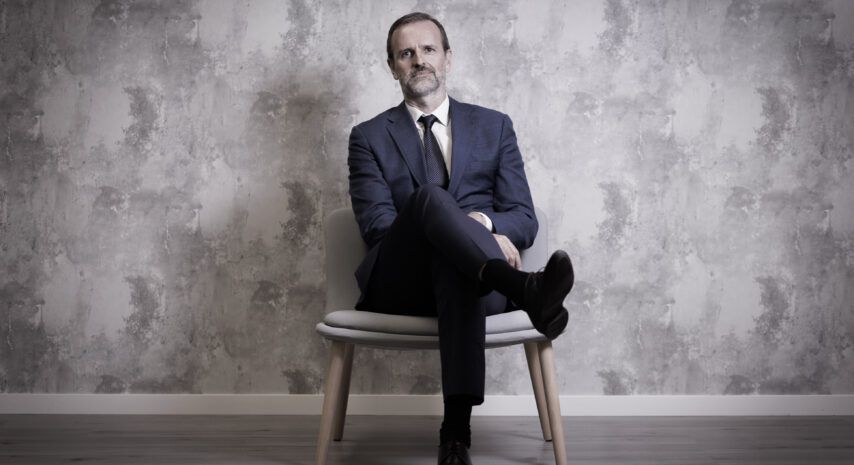
Xavier Coll
President of Westinghouse Spain“Nuclear energy is a crucial ally to achieve decarbonization”
Xavier Coll is President of Westinghouse Spain. With a distinguished career in the energy industry, he has held key roles in national and international nuclear project management and development. His leadership focuses on promoting innovation and sustainability within the nuclear sector, driving the implementation of advanced technologies and optimizing operations at nuclear power plants. In this interview with Foro Nuclear he emphasizes that Spain needs a “technical-strategic debate to determine the future of nuclear energy.”
As President and CEO of Westinghouse Spain, how would you describe the company's involvement in nuclear development in this country?
Westinghouse has played a fundamental role in developing the national nuclear sector through strategic alliances with key players such as Ensa, Enusa and Tecnatom. In Spain it has contributed to creating jobs, the transfer of knowledge and the optimization of operational services both here and worldwide.
We were a key player in the startup of the José Cabrera, Almaraz, Vandellós and Ascó nuclear power plants. Our engineering and operational support services have contributed to making Spanish nuclear power plants a global benchmark in terms of safety and efficiency.
What has been the role of the company you lead in the evolution of this industry over the years?
Over the past 20 years, the nuclear industry has undergone profound changes due to international events and geopolitical shifts, but it has gained global credibility. Public opinion and institutions acknowledge that nuclear energy is clean, decarbonized and available. Overall, this new scenario represents a boost for nuclear programs and the extension of the operational life of nuclear power plants.
“We are seeing a new scenario of boosting nuclear programs and extending the life of existing nuclear power plants”
Considering the significant growth achieved in the construction of new nuclear power plants in many countries, technological advancements for smaller-scale reactors for local use, and the fact that nuclear energy has the highest capacity factor of all energy sources (almost 94% compared to 35% for wind and 25% for solar), we have a highly clear future: nuclear energy is and will be a crucial ally to achieve decarbonization and an energy transition by 2050.
This means that investments in the sector will continue to rise, despite political resistance in countries like ours, given that technical data supports nuclear energy. It is our role to disseminate this data and have an increasing influence on public opinion in favor of using this type of energy. In fact, and I believe it is already happening, the majority of the Spanish population today shows more acceptance of nuclear energy than 10 or 20 years ago.
"Technical data supports nuclear energy, which has unquestionable benefits"
The acquisition of Tecnatom has been a significant milestone for Westinghouse. Could you share how the company has been strenghtened after this purchase?
Both Westinghouse and our clients and suppliers saw the potential union of these two companies as a natural progression, considering our more than sixty years of collaboration on various projects and cooperation agreements. We share a common vision: serving our clients with high-quality standards and offering technologically advanced products and services.
Tecnatom provides an excellent group of professionals who apply rigorous processes in their job, not only in the nuclear sector but also in non-nuclear applications such as inspection, simulation or training services for other industries. This acquisition makes us the largest nuclear services provider in Spain, with a permanent staff of over 1,200 professionals.
"More than sixty years of working together and sharing the same vision led us to acquire Tecnatom"
One of the highlights in the nuclear sector is the development of small modular reactors. How is Westinghouse contributing to this field?
Small Modular Reactors (SMRs) are increasingly important for achieving energy transition, for several reasons. Key aspects include lower capital investment, modular construction, flexibility and adaptability to local energy needs (high load-following capability), and the fact that they present the same safety and reliability conditions as large reactors like the AP1000®. In May 2023, Westinghouse launched its SMR product, the AP300™, a proven technology derived from the AP1000® with very similar licensing and the same supply chain.
All of this represents a radical change in nuclear energy in Europe and the rest of the world, which provides a positive boost to the sector and a shift in public opinion in many countries regarding the unquestionable benefits of this energy source.
“Small Modular Reactors are increasingly important to the achievement of an energy transition”
Could you share which prominent projects you are currenly working on at Westinghouse Spain here and globally?
Recently, various internal teams from Spain and the United States collaborated to launch the first AP1000® simulator, located at our headquarters in San Sebastián de los Reyes (Madrid). The project concluded in February of this year, which enabled executing the full simulation on a conventional laptop.

How do you evaluate the trajectory of this company, which celebrated its 50th anniversary in Spain in 2022?
The overall evaluation is highly positive; we are proud of our accomplishments over these past five decades: fostering collaboration with national companies, localizing assets, generating employment, facilitating knowledge transfer and locally implementing global technologies, products and services.
Key milestones include establishing the European Fuel Group (EFG) with Enusa in 1991; creating Westinghouse Technology Services with Ensa in 1997; acquiring the nuclear division of INITEC in 1999, and creating a joint venture with Tecnatom to coordinate reload services in 2005.
“We offer top-quality services for the safe and reliable operation of the national nuclear fleet"
What initiatives are you developing to attract talent, and how are you preparing the next generation of nuclear professionals for future challenges?
In Spain we have a close relationship with Jóvenes Nucleares, (the Spanish Nuclear Young Generation), a Spanish Nuclear Society (SNE) Commission that promotes the dissemination of nuclear science and technology and encourages the involvement of new generations in the sector. We actively participate in SNE's Employment and Professional Development Commission, offering activities such as scholarships, talent competitions, training and mentoring programs specifically designed to attract young talent.
Also, this year we finalized an agreement with Nebrija University in Spain to establish the first International Master's Degree Program in Nuclear Energy. Students from this institution will have the opportunity to intern at our company, which will provide professional opportunities in this field.
Additionally, we are developing other international initiatives aimed at recruiting young talent from various engineering universities worldwide to train the next generation of professionals.
From your perspective, what do you consider to be the main challenges and opportunitites that nuclear energy and the Spanish nuclear industry as a whole are currently facing?
Despite the favorable European trend towards nuclear energy, Spain remains an exception. The industry must strive to communicate the benefits of nuclear energy to drive a shift in public opinion.
The debate surrounding the future of nuclear power plants is not technological (since nuclear energy has proven reliability, cleanliness, and safety), but political. It requires a constructive discussion involving society, government, and businesses to extend the operational life of Spain's nuclear fleet. Finding a short-term solution without leveraging nuclear energy is extremely challenging. We only need to observe Germany's situation: after shutting down all their nuclear reactors they are now returning to gas as an energy source, which leads to increased CO2 emissions.
"We must extend the operation of the Spanish nuclear fleet"
What do you think are the myths associated with nuclear energy, and how could they be debunked?
The main myths surrounding nuclear energy are rooted in accidents that happened decades ago, which garnered widespread attention regarding potential harm and concerns over waste management and weapon proliferation.
The types of reactors currently operating in Spain, the safety conditions of modern nuclear power plants, and the lessons learned guarantee a safe operation. Regarding waste management, there is a debate that presents certain reservations due to a lack of knowledge, given that there are good enough solutions.
In conclusion, I believe we need to enhance communication and public outreach about the advantages and suitability of nuclear energy regardless of political decisions, in order to foster a technical-strategic debate that determines the future of nuclear energy in Spain and Europe.