IAEA increases its nuclear growth projections
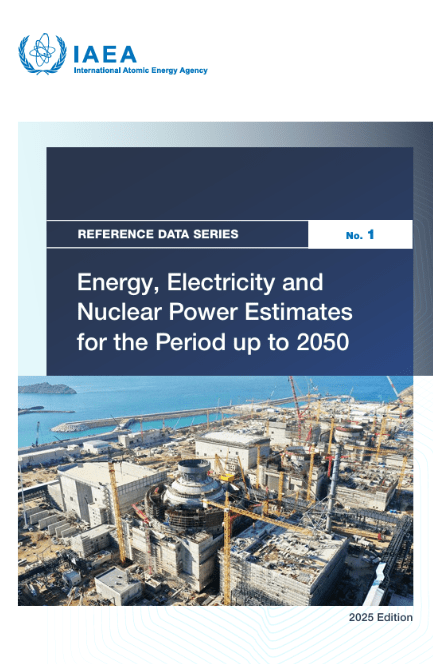
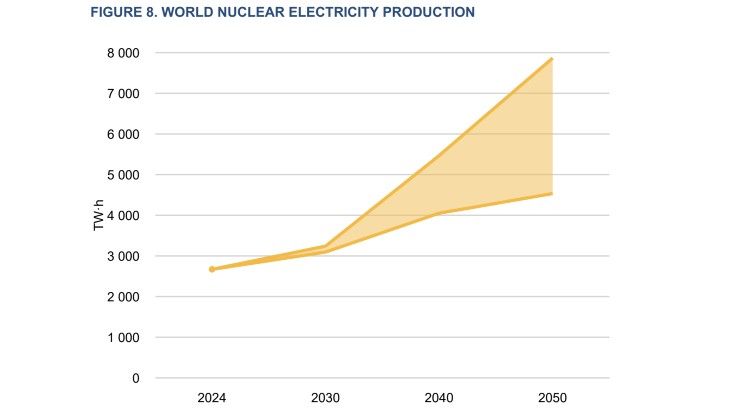
The International Atomic Energy Agency (IAEA) has increased its forecast for global nuclear power capacity. In its high-case scenario, it projects a rise from 377 GW in 2024 to 992 GW by 2050 — a 2.6-fold increase.
This is showcased in the IAEA's 45th edition of Energy, Electricity and Nuclear Power Estimates for the Period up to 2050 . Its findings were presented by IAEA Director General Rafael Mariano Grossi on the opening day of the Agency's General Conference in Vienna, Austria.
The scenario ranges from a 50% increase in capacity to SMRs delivering 24% of new capacity
At the end of 2024 there were 417 reactors in operation, delivering 377 GW. Another 62 reactors (~64.4 GW) are under construction, and 23 reactors (~19.7 GW) are in suspended operation.
In the low case scenario, IAEA explains, capacity is expected to increase by 50%, reaching 561 GW by 2050. The share of Small Modular Reactors (SMRs) differs greatly: in the high case SMRs would deliver about 24% of new capacity, whereas in the low case they’d provide 5%.
The scenario ranges from a 50% increase in capacity to SMRs delivering 24% of new capacity
This marks the fifth consecutive year of upward revisions. Since the first such increase after the 2011 Fukushima accident (in the 2021 edition), the high case forecast for 2050 has gone up about 25%, from 792 GW.
IAEA Director General Rafael Mariano Grossi said these rising projections reflect growing global agreement that nuclear energy is essential for clean, reliable, sustainable power.
These rising projections reflect a growing global agreement that nuclear energy is essential for clean, reliable, sustainable power
The report estimates capacity by considering existing reactors, possible license renewals, planned retirements, and projects under construction. The low case assumes current trends continue without major regulatory or policy changes. The high case assumes stronger national commitments, policies, investment, and regulatory support.
To meet the high case, about 26 GW of new capacity per year will be needed — far above the recent 5-year average of approximately 5.9 GW/year.
Power from nuclear reactors rose by 2.8% in 2024, while electricity production overall rose by approximately 3.4%, causing nuclear's share of electricity to dip slightly to 8.7%
The report also highlights that many reactors are aging. Extending their lifetimes is the most cost-effective way to maintain capacity. In the high case, retiring only about 81 GW of today's capacity by 2050 is assumed; in the low case, retirements amount to about 156 GW.
The IAEA report highlights that extending the operative life of reactors is the most cost-effective way to maintain capacity
Regionally, Central and Eastern Asia is expected to lead growth: nuclear capacity in that region could increase by about 15% by 2030 and 45% by 2050.
Grossi noted the challenges: newcomer countries need support, regulatory frameworks must evolve, financing must be made viable, and workforce and global harmonisation are critical.