Nuclear must be given a fair treatment for investment incentives
Nuclear energy must be recognized as a reliable, scalable and affordable low-carbon energy source, and given fair treatment fairly in investment incentives, according to the World Economic Forum (WEF).
The Switzerland-based think tank stressed nuclear's role in combating climate change but emphasized the need for private investment, even in markets where governments provide much of the financing.
“Governments need to take on the high initial capital costs,” the WEF said. “But attracting private financing through assured revenues and supportive policies is essential.”
Nuclear energy must be acknowledged as a reliable, scalable, and affordable low-carbon energy source and treated fairly in investment incentives, says the World Economic Forum
The WEF insisted on reforming policies that prevent nuclear investment by many international financial institutions. It also called on the industry to deliver projects on time and budget, adopt greater standardization and integrate safety and security in design. Regulators, the WEF said, must enable a tripling of nuclear capacity while maintaining safety and licensing next-generation reactors. "Nuclear energy is a cross-border effort," the WEF noted, stressing the importance of international cooperation.
Governments need to cover the high capital costs of nuclear projects, but also attract private financing through assured revenues and supportive policies, said the WEF
Changes in the West
At the Davos 2025 panel, Sweden’s deputy prime minister Ebba Busch highlighted growing support for nuclear energy, driven by “facts, physics, and hope for the future.” She emphasized nuclear’s critical role as a 24/7 energy source for heavy industry.
Busch outlined Sweden’s financing model, including state loans, long-term contracts and risk-sharing mechanisms, which are expected to pass parliament this spring.
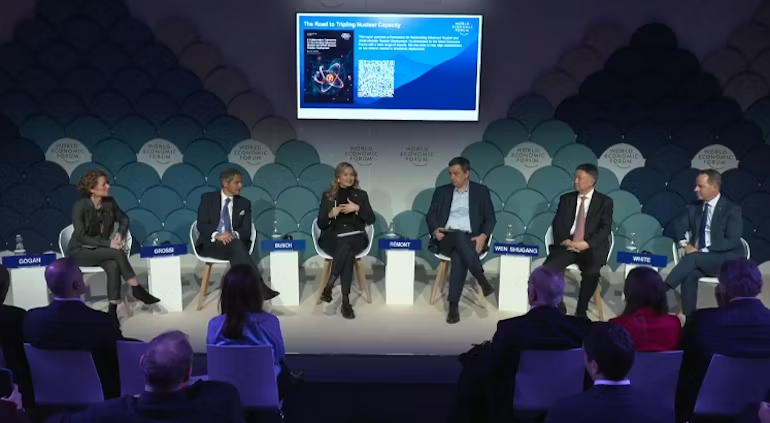
While China is set to triple its nuclear capacity by 2050, the West faces significant regulatory, financial, and political challenges that must be addressed
International Atomic Energy Agency director Rafael Grossi noted that while China is on track to triple its nuclear capacity by 2050, the West faces regulatory, financial, and political challenges that must be addressed for nuclear energy to reach its potential.
Source: NucNet