Foro Nuclear joins the international nuclear industry in a joint declaration ahead of COP30
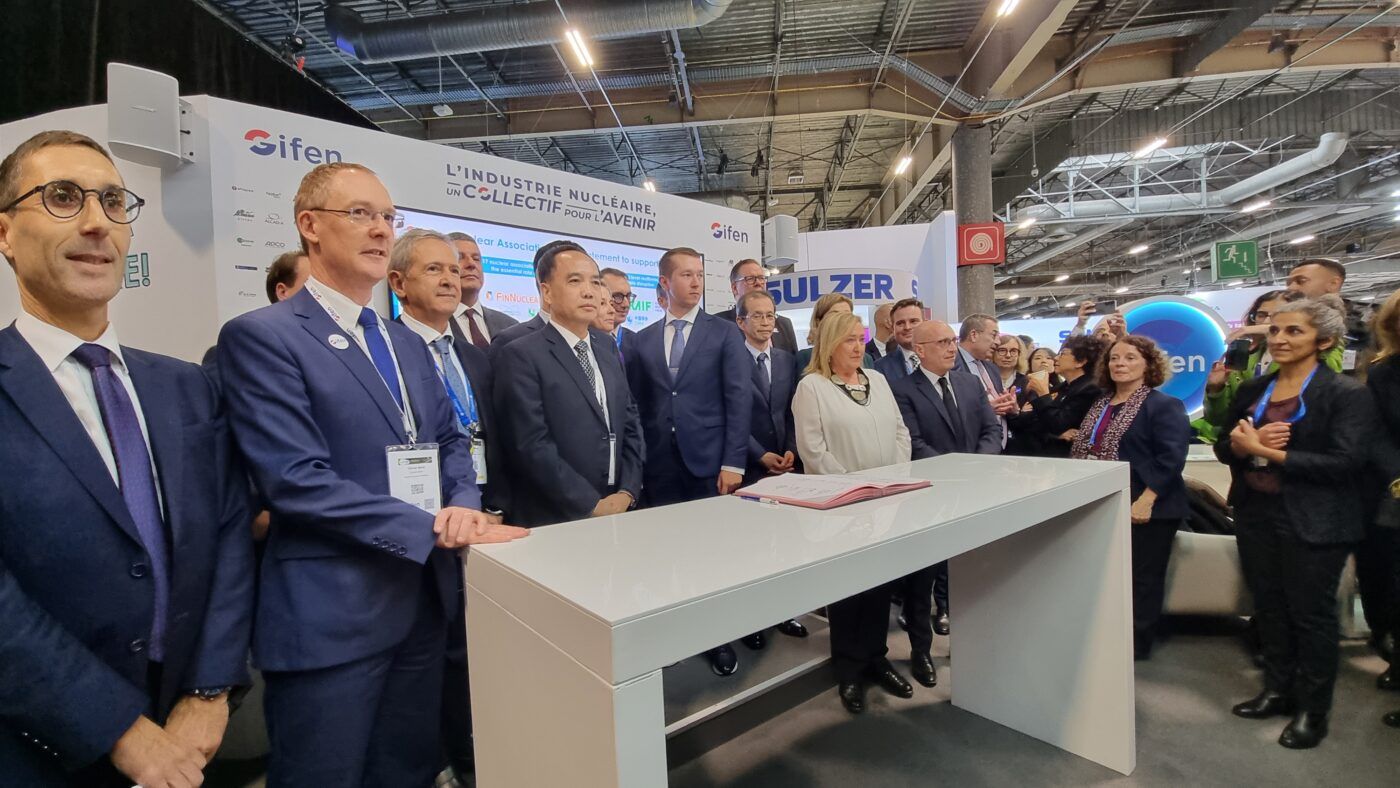
On the occasion of World Nuclear Exhibition (WNE 2025) and ahead of COP30 in Brazil, 17 national and international nuclear industry associations from 15 countries across three continents, including Foro Nuclear, have signed a joint declaration calling for a global commitment to triple nuclear capacity by 2050.
Foro Nuclear signed this joint declaration along with GIFEN (France), WNA, Nuclear Europe, NIA (UK), FinNuclear (Finland), ABDAN (Brazil), BNF (Belgium), AIN (Italy), Nuclear Nederland (Netherlands), CNA (Canada), SNF (Switzerland), JAIF (Japan), KAIF (South Korea), IGEOS (Poland), CNEA (China) and ROMATOM (Romania).
This unprecedented coalition, launched by the French Nuclear Industry (GIFEN) in coordination with the World Nuclear Association (WNA), highlights the industry’s shared determination to ensure stable policies and adequate financing to achieve climate goals and guarantee access to reliable, low-carbon energy.
The coalition highlights the industry's determination to ensure stable policies and adequate financing to achieve climate goals
Nuclear power, as a dispatchable, low-carbon and competitive energy source, is essential for grid stability and deep decarbonization. It already provides 23% of the world’s low-carbon electricity. It has prevented around 70 Gt of CO₂ in the last 50 years — a figure that could reach 90 Gt by 2050, according to the International Energy Agency (IEA) and the International Atomic Energy Agency (IAEA).
The declaration urges policymakers to support the extension of existing plants, the construction of new projects — from large reactors to SMRs and AMRs — and greater investment throughout the nuclear fuel cycle. It also calls for wider access to green finance and policies that encourage innovation and R&D.
The declaration urges policymakers to support life extension for existing plants, construction of new projects and greater invesment
Advances in SMRs, AMRs and Generation IV technologies open the door to new uses such as industrial heat, hydrogen production, healthcare, and maritime or space applications. With exceptional energy density and a small material footprint, nuclear power contributes to resource conservation, biodiversity protection, and the creation of skilled jobs worldwide.
Nuclear power contributes to resource conservation, biodiversity protection and job creation
This global initiative sends a clear signal to decisionmakers: the nuclear sector is ready to invest, accelerate and deliver—provided that stable, predictable frameworks support its contribution to climate objectives and energy security.