What is the INES scale, and how are nuclear and radiological events classified?
The International Nuclear and Radiological Event Scale (INES) is an internationally used tool for the simple and consistent classification and communication of the significance of nuclear and radiological events as well as their implications for safety.
In 2026, the United Nations International Atomic Energy Agency (IAEA) and the OECD Nuclear Energy Agency (NEA) published a new edition of the INES Scale manual, updating the previous 2008 edition and incorporating the experience gained over the past years.
A common language to explain events
The INES Scale was introduced in 1990 with the purpose of establishing a common assessment system across countries and providing the public and the media with clear, understandable information on the safety significance of a particular nuclear or radiological event.
The INES Scale is an assessment system designed to provide the public and the media with information on the safety significance of a particular event
To this end, internationally agreed criteria were established that take into acco7unt the potential impact on people, facilities and the environment.
Initially, INES focused on events that took place at nuclear power plants. Afterwards, its scope was extended to other nuclear and radioactive sites, the transport of radioactive materials and certain activities involving the use of radiation sources.
The main purpose of this scale is to put events into perspective and make them easier to understand. It does not replace a detailed technical analysis of an event; rather, it provides a common language for communicating its safety significance. The manual states that the INES level should be accompanied by information that enables correct interpretation.
Seven levels: from anomaly to major accident
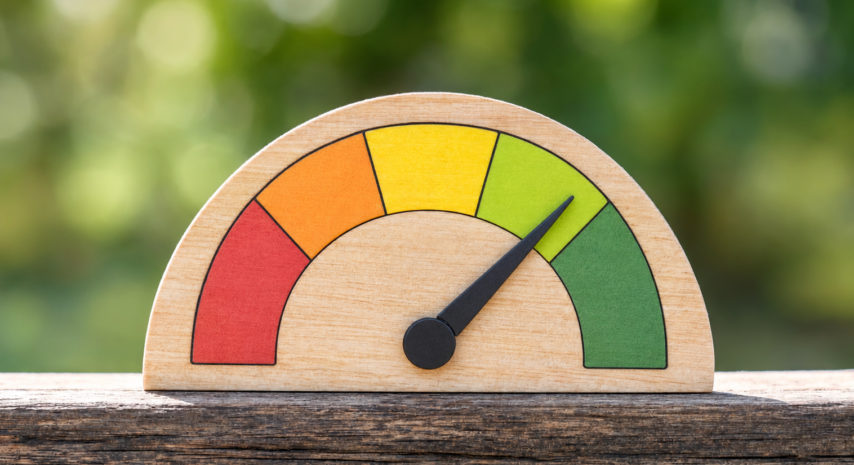
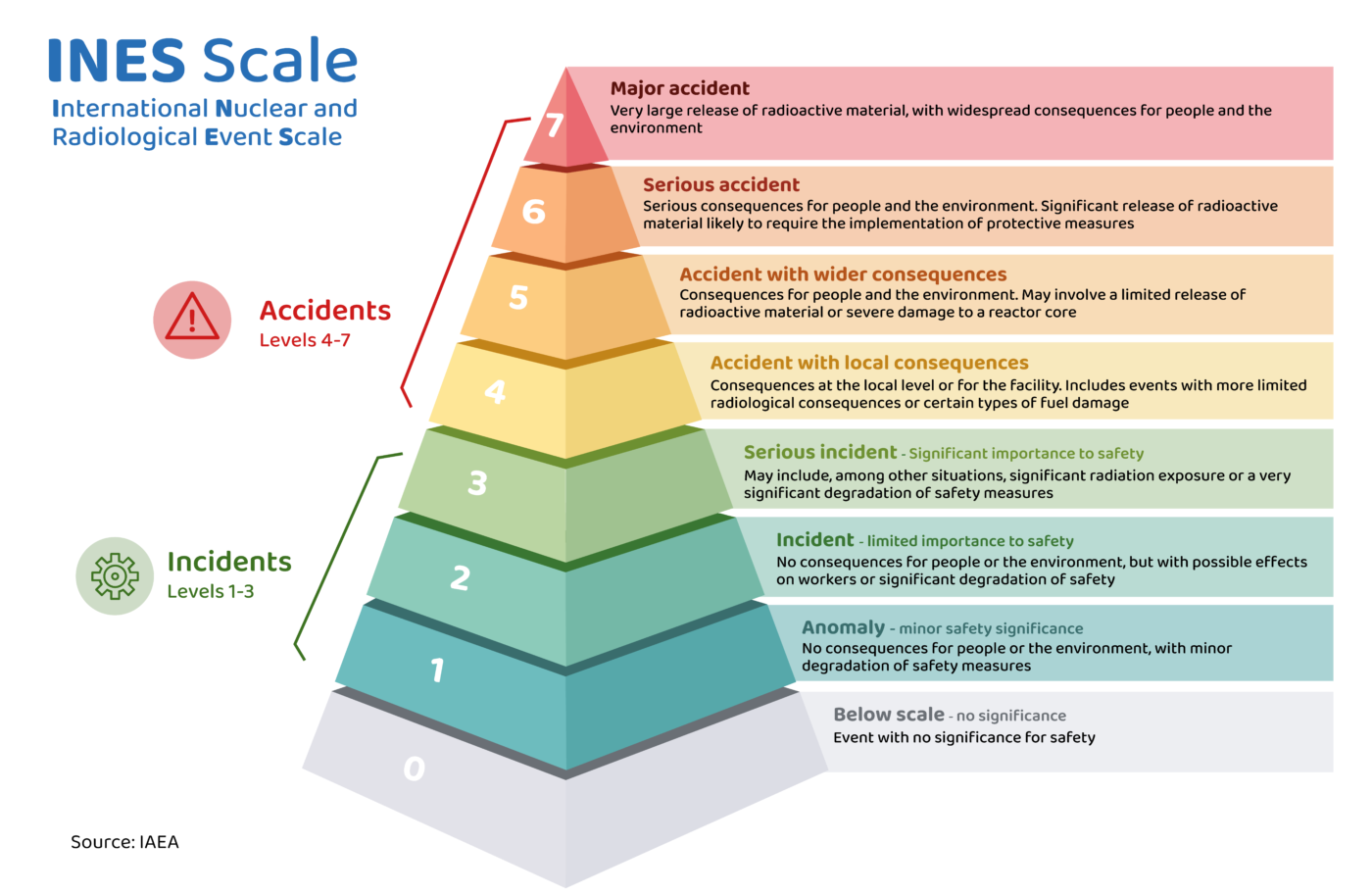
The INES Scale comprises seven levels, in order of increasing safety significance. Levels 1, 2 and 3 are classified as incidents, while levels 4, 5 and 6 are classified as accidents.
The INES Scale comprises seven levels. Levels 1 to 3 are classified as incidents; levels 4 to 7 are classified as accidents
Below these is level 0, or "below scale", which is reserved for events with no safety significance. The new manual states that an event is classified as level 0 when full application of the methodology does not result in a higher level.
As shown in the graphic, the seven levels are:
- Incidents
- Level 1 - Anomaly
- Level 2 - Incident
- Level 3 - Serious incident
- Accidents
- Level 4 - Accident with local consequences
- Level 5 - Accident with wider consequences
- Level 6 - Serious accident
- Level 7 - Major accident
How is the INES level determined?
The classification of an event does not depend solely on whether or not a radioactive release has occurred. The current INES methodology considers three main areas:
- People and the environment. The radiological consequences for people and the environment are assessed, taking into account factors such as radiation doses received or the amount of radioactive material released.
- Radiological barriers and controls. The effectiveness of the barriers and systems designed to keep radioactive material contained and under control within facilities is assessed.
- Defence in depth. The effectiveness of the successive layers of protection—equipment, systems, procedures and other measures—designed to prevent an accident or limit its consequences is assessed.
The event is assessed according to the applicable areas and classified at the highest level obtained. This explains why an event may have safety significance even if it has caused no harm to people and no radioactive releases to the environment. Its potential consequences and the degradation of safety measures are also taken into account.
What INES is not
INES is not intended to compare the safety of different nuclear power plants, operating companies or countries. Reporting practices may vary and the methodology itself has evolved over time, so comparing the number of classified events can lead to misleading conclusions.
Nor is it a system for determining the response to an emergency. Protective measures are decided on the basis of the actual situation and the applicable plans and procedures, not the assigned INES level.
The INES Scale provides a means of communicating the safety significance of an event. It is not an emergency classification system or a tool for comparing facilities or countries
Changes in classification
A change in level does not mean that the event itself has changed. Rather, its classification is updated when sufficient information becomes available to properly assess its safety significance.
Among the best-known international events, Three Mile Island (1979) was classified as Level 5, while Chernobyl (1986) and Fukushima Daiichi (2011) were classified as Level 7, a major accident and the highest level on the scale.
These two examples show that two events classified at the same INES level do not necessarily have the same characteristics or consequences.
Two events classified at the same INES level do not necessarily have the same characteristics or consequences
An updated scale to improve communication
The new 2026 edition of the INES Manual updates the methodology and guidance for applying the scale, drawing on international experience gained, including lessons learned from Fukushima Daiichi.
More than three decades after its introduction, INES continues to provide a common language for putting nuclear and radiological events into perspective and explaining their safety significance. The 2026 update reinforces this role and helps authorities, professionals, the media and the public to gain a better understanding of the significance of these events.
Sources: IAEA and Foro Nuclear