The importance of diversifying electricity generation sources, according to EPRI
The U.S.-based Electric Power Research Institute (EPRI) has just published its 2026 technical report, Energy Supply and Security Study, which provides a comprehensive global analysis of energy supply and security.
The energy trilemma
The report prepared by EPRI examines how enBFergy supply has evolved across different regions, as well as the changes observed in the energy trilemma:
- Security or reliability: The report assesses cases of supply shortfalls that have led to blackouts, rolling outages or emergency measures to prevent the collapse of regional systems.
- Equity or affordability: It analyses household/residential electricity rates as a relative indicator across regions.
- Sustainability: It examines greenhouse gas emissions per unit of energy, as well as relative indicators across regions.
EPRI conducted this study to understand how changing energy supply dynamics affect energy security and system reliability under varying conditions, and to identify the strategies needed to ensure resource adequacy and maintain system resilience in a future grid powered by a diverse mix of energy sources.

The study's main results
- Time scales are a critical dimension of energy security. While annual energy mixes provide insight into sustainability goals, they can create a false sense of confidence about grid stability. Supply-demand imbalances can trigger system failures within seconds, as demonstrated by the frequency disturbances on the Iberian Peninsula, or within minutes after several days of sustained stress, as occurred during winter storm Uri in Texas in 2021. Accurately assessing risk requires granular analyses of hourly demand and ramping capabilities across multiple scenarios.
- Affordability has reached a critical threshold in some of the regions examined. Germany and the United Kingdom stand out for their high electricity costs, marked by a widening gap between domestic electricity production and household electricity prices between 2015 and 2024.
- In the United Kingdom, domestic electricity generation fell by 24%, while nominal household electricity prices rose sharply from around 21 to 39 euro cents/kWh.
- In Germany, domestic electricity generation declined by 25%, while nominal household electricity prices increased from approximately 30 to 40 euro cents/kWh.
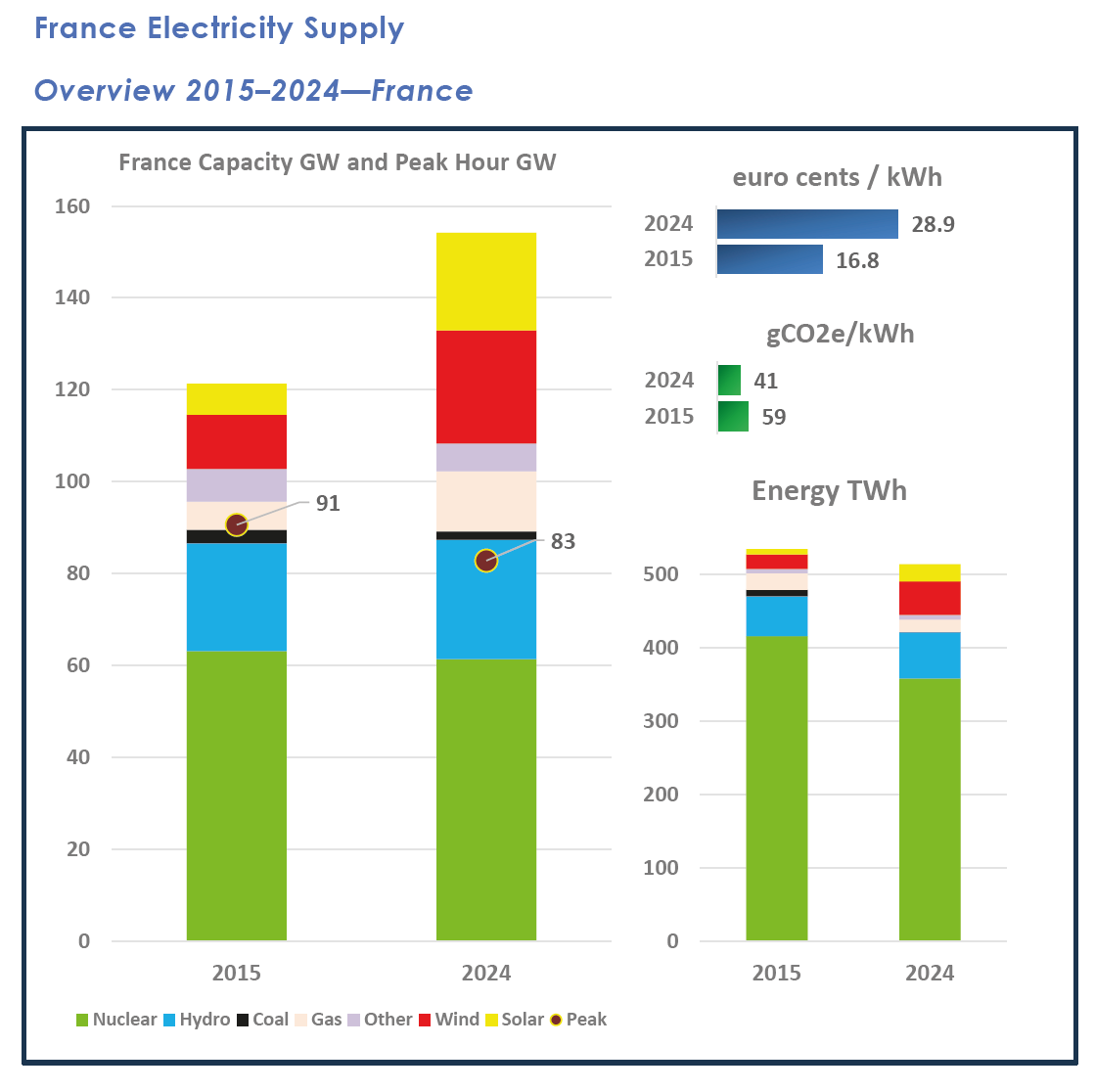
- This performance is underpinned by France's strong nuclear fleet, which accounts for 67% of the country's total electricity generation. Combined with hydropower and wind energy, more than 95% of French electricity is now generated from low-carbon sources.
- Unlike regions experiencing supply-demand imbalances, France's reliance on nuclear energy provides a stable, low-carbon foundation that supports both domestic grid security and substantial electricity exports to neighbouring countries.
This correlation suggests that, as firm domestic generating capacity was retired, the resulting dependence on electricity imports and volatile wholesale markets significantly undermined affordability for consumers.
- In contrast to the European trend, China and India have maintained stable electricity prices despite rising demand. Both countries have prioritised energy security and industrial competitiveness, relying primarily on domestic coal to meet their growing energy needs. Over the past 20 years, wind and solar have each contributed less than 20% of total electricity generation in both countries.
- In terms of sustainability and greenhouse gas emissions, France remains the benchmark among the world's major economies. In 2024, it maintained an emissions intensity of approximately 41 gCO₂e/kWh, the lowest of any G20 nation.
- France's carbon intensity is approximately three times lower than Spain's, four times lower than California's, five times lower than the United Kingdom's, and eight times lower than Germany's.
France's strong commitment to nuclear energy provides a firm foundation of low-carbon electricity
Additional results
- Many regions, including North America, Asia, South America and Europe, have experienced events that caused rolling outages or widespread blackouts. In the United States, such events have often coincided with the Department of Energy's use of its emergency authority under the Federal Power Act. Recent examples of nationwide blackouts include Chile (2025) and the Iberian Peninsula (Spain and Portugal, 2025).
- California is a leading example of the economic and operational challenges associated with high solar penetration. Despite large-scale deployment, the marginal value of solar continues to decline, leading to negative prices and rising curtailment in the spring.
- During February, March and April, midday solar generation frequently exceeds demand, driving wholesale electricity prices below zero.
- By early 2025, California had surpassed 10 GW of battery storage capacity, but this has not reversed the increase in curtailment.
- Battery storage has significantly mitigated the "net peak" risk—the period during summer evenings when solar generation declines while electricity demand remains high—virtually eliminating the risk of summer rolling outages.
- Four-hour battery systems have reduced the hourly peak demand for natural gas generation but have not lowered overall daily reliance on natural gas during the summer.
- Since 2019, the daily energy required from non-solar, non-wind and non-battery resources—primarily natural gas and electricity imports—has remained largely unchanged, despite the addition of 20 GW of new solar and battery capacity.
- Spain and Germany exhibit a significant "displacement gap," where investment in renewable capacity (solar and wind) has not substantially reduced the daily need for firm, non-renewable energy.
- Between 2015 and 2024, Germany added nearly 90 GW of solar and wind capacity. Despite this major expansion, the maximum daily energy required from non-renewable resources (coal, natural gas and electricity imports) declined by less than 10% compared with 2015.
- Spain added 30 GW of solar and wind capacity, yet its daily reliance on firm resources remains essentially unchanged from 2015 levels.
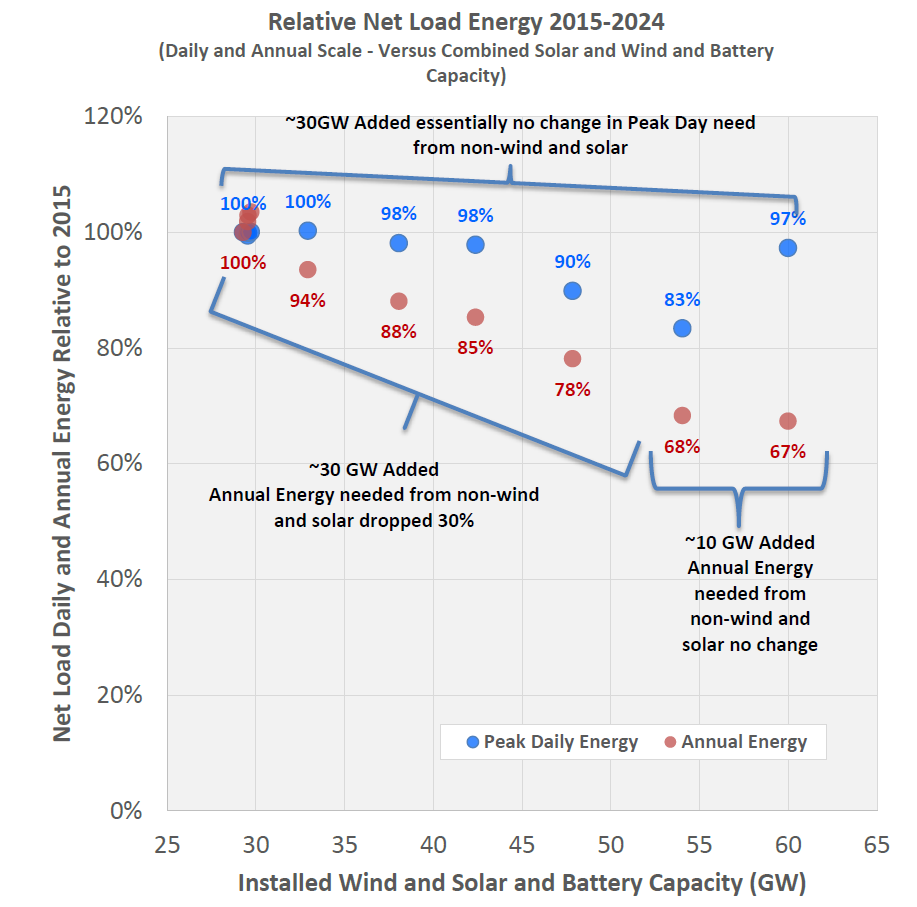
According to EPRI, investment in renewable capacity does not significantly reduce the daily need for firm energy
These findings suggest that the current integration of renewable energy is creating a parallel system rather than a replacement system. Because solar and wind power are not dispatchable, the grid must retain almost its entire original fleet of firm generating capacity to meet demand during periods of low renewable output—a phenomenon known in German as dunkelflaute ("dark doldrums").
- In November 2024, a regional-scale dunkelflaute—a weather event characterised by prolonged periods of low wind and little or no sunlight—caused renewable generation across the European Union to collapse for approximately six days (140 hours).
- Despite an installed wind and solar capacity of more than 480 GW, average output during that period fell to just 39 GW. For 140 consecutive hours, the entire EU27 wind and solar fleet operated at less than 10% of its installed capacity.
This event shows that a power system heavily reliant on wind and solar must retain almost 100% backup capacity from firm, dispatchable resources (such as nuclear, natural gas or coal) to prevent a complete system failure during extended periods of atmospheric stagnation.
- In 2016, Germany was a major electricity exporter to Central Europe. By 2024, however, the loss of firm nuclear baseload capacity had led to a structural dependence on electricity imports, natural gas and coal to stabilise the grid during periods of peak demand.
- High-cost imports during shortages: During periods of low renewable generation, Germany must import electricity at high cost.
- Negative-price exports during periods of surplus: During periods of strong wind or abundant sunshine, excess generation drives wholesale electricity prices below zero, forcing Germany to pay neighbouring countries to absorb surplus electricity.
This reliance on fossil-fuel peaking plants and high-carbon electricity imports has kept Germany's greenhouse gas emissions intensity significantly above the EU27 average and well above that of neighbouring countries such as France.
- The energy transitions in Germany and the United Kingdom are approaching a firm-capacity threshold. Although annual natural gas consumption may fluctuate, the maximum daily reliance on gas-fired generation has reached record levels.
- Record gas generation peaks: Contrary to expectations of a steadily declining fossil fuel footprint, the highest daily levels of gas-fired electricity generation in both countries were recorded in 2024 and 2025.
- As coal- and nuclear-fired power plants have been retired, natural gas has become the only balancing resource capable of covering large renewable generation shortfalls during periods of high demand.
- Meeting these growing peak requirements requires maintaining a large, costly and underutilised fleet of gas-fired power plants and associated pipeline infrastructure, directly increasing system costs passed on to consumers while also posing risks to energy security.
The 2025 Iberian Peninsula blackout shifted the operating strategy from maximizing renewable generation to mandatory reliability
- According to EPRI's analysis, the 2025 Iberian Peninsula blackout forced a fundamental shift in the operation of Spain's electricity system, moving from a strategy focused on maximizing renewable generation to one based on mandatory reliability requirements (known in Spain as operación reforzada, or "reinforced operation").
- Since the collapse of the system on 28 April 2025, Spain has significantly increased the number of gas-fired generating units kept in continuous operation. This ensures that the grid has sufficient reactive power and system inertia—essential services that inverter-based renewable generation was unable to provide adequately during the frequency disturbances that triggered the blackout.
- The blackout was characterized by a voltage instability event in which generation disconnections triggered further voltage spikes. Keeping gas-fired units synchronised with the grid, even during periods of high solar and wind generation, provides a damping effect that helps prevent local disturbances from cascading into a peninsula-wide security event.
- This need to keep gas-fired units continuously synchronised raises the minimum level of fossil-fuel generation required, placing a limit on the amount of renewable electricity that can be accommodated without increasing the risk of system collapse.
- EPRI's analysis also indicates that, after twenty years of stagnant electricity demand, the United States has entered a new era of rapid growth driven by electrification and the expansion of artificial intelligence (AI) infrastructure.
- Despite the ongoing energy transition, 2024 and 2025 saw record daily peaks in coal- and natural gas-fired electricity generation. For the first time, winter demand peaks required more than 9 TWh of thermal generation in a single day, underscoring that natural gas remains the ultimate source of reliability during extreme cold-weather events, such as the January 2025 polar vortex.
- Rapid demand growth is no longer a future projection—it is an operational reality. The expansion of AI data centres is concentrated in specific locations, creating localised energy security risks where load growth is outpacing the development of new transmission infrastructure and firm generation capacity.
- As of early 2026, the U.S. power system faces a paradox: although solar and battery storage account for most new generating capacity additions, the existing fossil-fuel fleet is working harder than ever to bridge supply gaps during peak demand periods and extreme weather events.
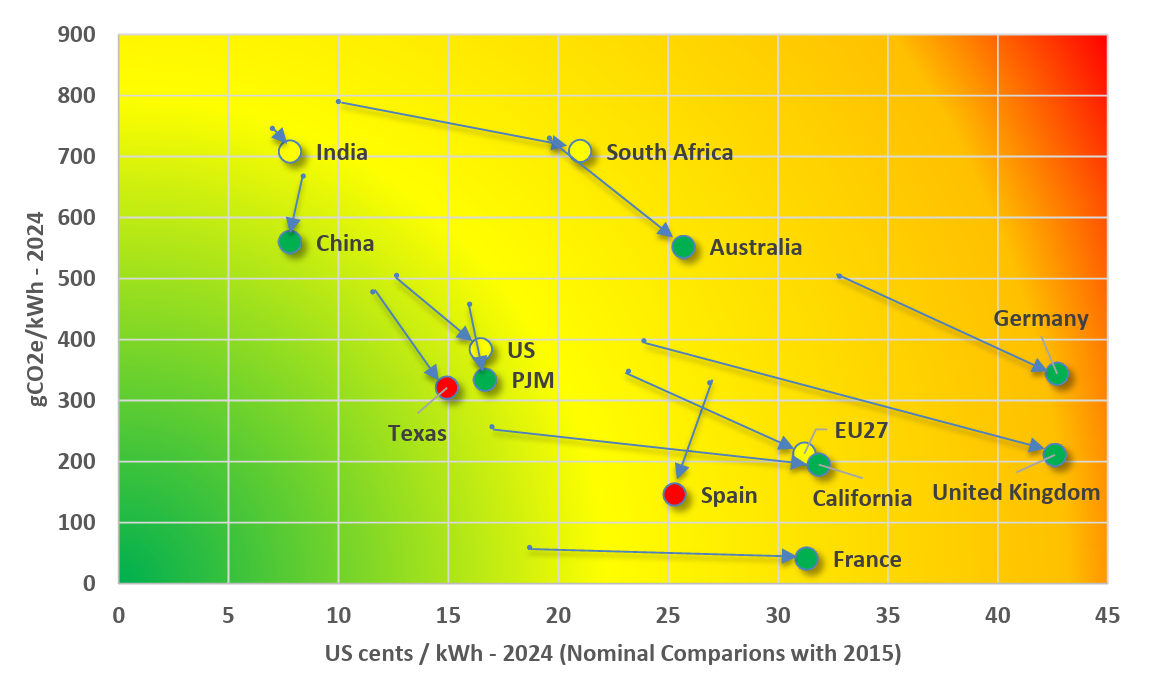
EPRI recommends that future energy mixes should be sustainable, affordable and resilient
Conclusions
The EPRI report concludes that these findings highlight the diverse challenges and systemic trade-offs involved in meeting the energy trilemma of security, affordability and sustainability. They underscore the need to assess energy supply at high temporal resolution—analysing every hour of the year—and to consider the full range of attributes offered by different generation technologies and supporting infrastructure to ensure that future energy mixes are resilient, affordable and sustainable. A diversified energy mix can better support environmental objectives, strengthen security of supply and deliver competitively priced electricity.
Source: Electric Power Research Institute (EPRI)
Disclaimer: The Electric Power Research Institute, Inc. (“EPRI”) assumes no liability with respect to the translation or use of, or for damages resulting from the translation or use of the information contained herein. Further, EPRI makes no warranty or representations, expressed or implied with respect to the accuracy or completeness of the translation or the usefulness of the information contained herein.