Global collaboration: a key driver of nuclear growth worldwide
The OECD Nuclear Energy Agency (NEA) has published a new report, Nuclear Energy Outlook: Global Installed Capacity to 2050 and Beyond, which assesses the current state and future trajectory of nuclear energy worldwide. It concludes that, to meet global ambitions to significantly increase installed nuclear capacity, it will be necessary to substantially accelerate the workforce, supply chains, and the availability of financing.
The nuclear sector is at a critical juncture after decades without constructing new reactors in most OECD countries. Today, an increasing number of governments, both within OECD member states and across the Global South, are repositioning nuclear energy as a central component of energy security, environmental objectives, and industrial competitiveness.
The OECD Nuclear Energy Agency warns that tripling global nuclear capacity by 2050 will require unprecedented cooperation among governments, industry and financial institutions
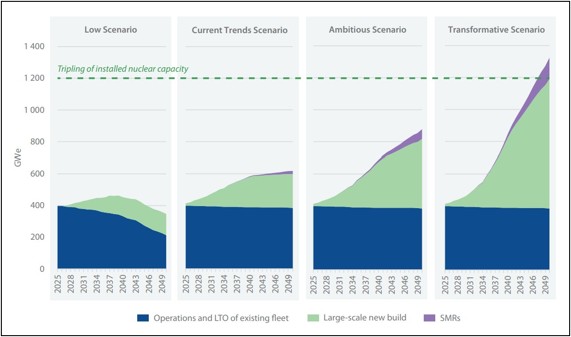
The report outlines four scenarios that describe how global installed nuclear capacity could evolve through 2050 and beyond, taking into account the refurbishment and modernization of numerous units and the long‑term operation of the existing nuclear fleet, as well as new builds of large reactors and small modular reactors (SMRs):
- Low scenario: Global installed nuclear capacity reaches only 347 GWe by 2050, as plant retirements in OECD countries offset new projects and the recent momentum does not translate into sustained deployment.
- Current Trends scenario: Global capacity reaches 619 GWe, driven largely by planned and proposed projects outside the OECD.
- Ambitious scenario: Global capacity reaches 883 GWe, with a greater contribution from new builds and SMRs.
- Transformative scenario: Global capacity reaches approximately 1,324 GWe by 2050, more than three times current global capacity. This scenario is driven by long‑term national capacity targets —including the United States’ objective to quadruple capacity by 2050 and India’s target of 100 GWe by 2047— combined with successful long‑term operations, an acceleration of large‑scale construction, and significant SMR deployment.
As the report details, tripling installed nuclear capacity by 2050 is achieved only under the Transformative scenario, which, in OECD countries, will require substantial changes in government policy as well as in project delivery, industrial capacity, and financing.
The NEA report examines the current state and future of nuclear energy worldwide. Its most ambitious scenario projects installed nuclear capacity reaching 1,324 GWe by 2050, more than triple today's capacity
The essential role of existing reactors
The long‑term operation of the existing nuclear fleet remains a key factor in meeting targets. Many reactors in OECD countries will reach the end of their initial operating authorizations before 2040. Extending operation to 60 years and, increasingly, to 80 years could preserve reliable, low‑carbon capacity, support energy security, and avoid the need to replace large volumes of firm generation within a short timeframe.
Extending the operation of existing nuclear reactors to 60 and 80 years will be key to achieving energy and climate goals
However, OECD countries face a serious risk of losing critical nuclear facilities. The report estimates that plants representing more than 50 GWe of nuclear capacity in the OECD do not yet have licenses to operate through 2040. Renewing those licenses to enable continued operation is essential.
Change in the geography of nuclear development
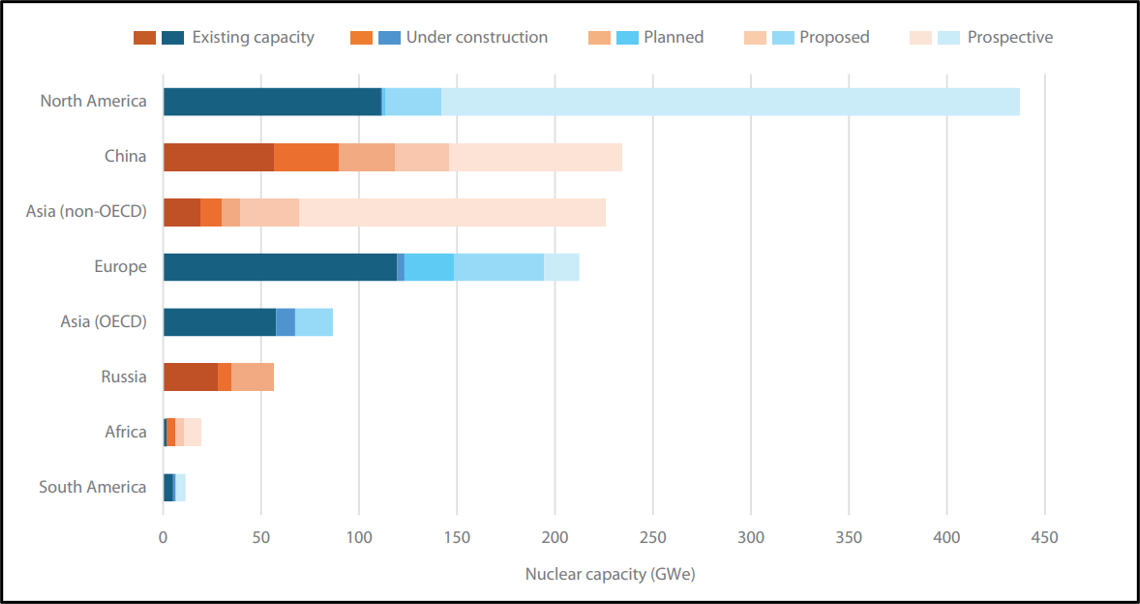
Beyond capacity increases, the NEA highlights a shift in the locations where nuclear energy is being developed. Although OECD countries currently account for approximately 78% of operating global nuclear capacity, non‑OECD countries are driving most of the near‑term expansion: of the 70 GWe under construction, roughly 80% is located in non‑OECD countries, led by China with more than 33 GWe.
El 80% de la nueva capacidad nuclear actualmente en construcción se concentra en países no pertenecientes a la OCDE
The report also underscores the strategic importance of technological choices and supplier competition. China and Russia currently occupy strong positions in the international nuclear market, while suppliers from OECD countries retain a significant but less mature project portfolio.
Addressing supply chain, workforce and financing challenges
Achieving more ambitious targets will depend on overcoming challenges related to supply chains and the workforce. In many OECD countries, limited new‑build activity over the past 25 years has weakened industrial capabilities and project execution expertise. Overcoming this challenge will require close cooperation among like‑minded countries, stronger industrial partnerships, and a shift from a project‑centric approach to program‑based deployment.
Financing will also be a decisive factor. Recent investment in new nuclear power has averaged roughly $30 billion per year, driven primarily by China and Russia. To reach scenarios requiring greater investment, this figure must increase substantially. In OECD countries, annual capital requirements would need to rise from about $12 billion in the past decade to an average of $68 billion under the Ambitious scenario and $143 billion under the Transformative scenario. During the 2030s, the Transformative scenario could raise OECD capital requirements to nearly $200 billion per year.
Financing, supply chains and the availability of skilled workers are the main challenges facing nuclear expansion
Given constraints on public budgets, mobilizing private capital will be essential. This will require clear risk allocation, credible revenue models, and government‑backed mechanisms that reduce construction, market and policy uncertainties.
In short, the Nuclear Energy Agency emphasizes that closing the gap between ambition and delivery will demand joint efforts by governments, industry, and financial institutions. Only through unified action can existing deployment barriers be overcome and support secured for the next phase of nuclear energy development.
Source: OECD Nuclear Energy Agency